
The eBooks we sell are sold as a single-user licence and are intended for the end user only.
The sale of some eBooks are restricted to certain countries. To alert you to such restrictions, please select the country of the billing address of your credit or debit card you wish to use for payment.
For further information see https://www.wildy.com/ebook-formats
Once the order is confirmed an e-mail will be sent to you to allow you to download the eBook. For UK purchases this will be automatic. For purchases outside the UK a member of staff will need to confirm the sale. (Staff are available to do this during normal business hours, Mon-Fri 8:30-17:00 UK time)
All eBooks are supplied firm sale and cannot be returned. If you believe there is a fault with your eBook then contact us on ebooks@wildy.com and we will help in resolving the issue. This does not affect your statutory rights.
From 2015, ASEAN transforms itself from a loose economic cooperation with nearly four hundred binding treaties and innumerable communiqués, protocols, and other regional instruments on agriculture and property ownership, trade, investment, telecommunications and information, energy and natural resources, aviation and maritime security, interconnectivity, transport and infrastructure development. These international instruments will be carried over and amplified under the new governance system for ASEAN when the Southeast Asian states integrate under a single market in 2015.
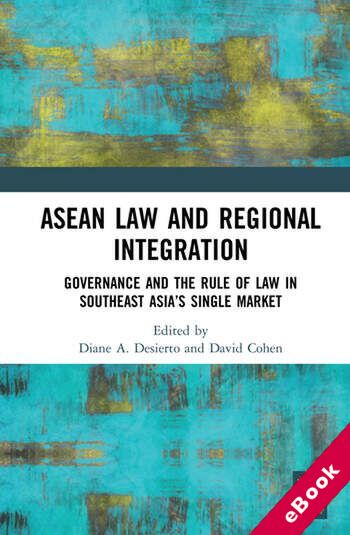
This edited collection is a concise and authoritative volume covering the practical, doctrinal, legal, and policy aspects of the new regime of ASEAN Law. Drawing together contributions from a range of key thinkers in the field, the editors present the legal and policy-making issues implicated in the practical implementation and operation of Southeast Asia’s single market allowing for free movement of goods, services, capital, and labour. The book also examines the nature of regional law-making under ASEAN before and after the commencement of regional integration in 2015, the nature of ASEAN’s public and private partnership models, as well as the evolving structure for enforcement and harmonization of ‘ASEAN Law’ through the array of Southeast Asian national courts, designated arbitral tribunals, and the incipient mechanisms for inter-State, intra-regional, and individual-State conflict management and dispute resolution.
This book will be of great relevance to students, scholars and policy-makers with an interest in ASEAN law and policy, and Southeast Asian studies in general.











