
Wildy Logo
(020) 7242 5778
enquiries@wildy.com

Book of the Month

Cover of Housing Law Handbook

Housing Law Handbook

Price: £85.00

Planning Law:
A Practitioner's
Handbook 2nd ed


 William Webster, Robert Weatherley


Welcome to Wildys

Watch


Corporate Insolvency Practice:
Litigation, Procedure
and Precedents 3rd ed


 Mark Watson-Gandy


Offers for Newly Called Barristers & Students

Special Discounts for Newly Called & Students

Read More ...


Secondhand & Out of Print

Browse Secondhand Online

Read More...


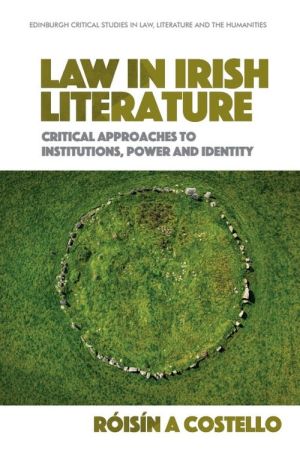
Law in Irish Literature: Critical Approaches to Institutions, Power and Identity


ISBN13: 9781399515511
To be Published: January 2027
Publisher: Edinburgh University Press
Country of Publication: UK
Format: Hardback
Price: £90.00


Explores the interaction of law and literature in an Irish context and illustrates the broader decolonial and intersectional role literature can play in thinking about law and legal institutions

  • Provides the first literary critique and analysis of Irish authors’ portrayal of law
  • Draws together the work of Irish authors working in both the official and national languages of the State
  • Draws on a range of texts including novels, poetry, plays, song and satire
  • Presents new readings of the satire of Bres Mac Eladain, the macaronic song An Trucailín Donn, Edmund Spenser’s , Brian Merriman’s Cúirt an Mheán Oíche, Máiréad Ní Ghráda’s An Triail, James Joyce’s Ulysses, Brian O’Nolan’s Cruiskeen Court, Colm Toibín’s The Heather Blazing and Brian Friel’s Making History and Translations
  • Draws on cases including Ní Cheallaigh v Minister for the Environment, R v Edalji, the Ma’amtrasna murder trials and The United States v One Book Called Ulysses

Róisín Á Costello provides a critical analysis of the ways in which law is portrayed in Irish literature and argues that authors from Ireland (writing in both Irish and English) have consistently used literature as a mechanism to challenge and critique institutional power. In doing so, she argues that Irish literature, and the narratives it has created about law, have been used to re-assert and recomplicate Irish identities at sites of conflict and to interrogate the legitimacy of power and how it is exercised.

Drawing on a range of texts including novels, poetry, plays, song and satire, Costello illustrates that Irish literature has acted as a decolonial and intersectional force in critiquing the institution of law and constructing national, linguistic and political identities in Ireland. She traces a pattern in which Irish authors consistently used literature as a lens for legal analysis in Ireland, using their work to address fundamental concerns about the legitimacy of law, the role of doubt in legal proceedings, the need for popular accountability, and the marginalisation of minority groups an identities by formal institutions and system.


Subjects:
Law and Literature
Contents:
Acknowledgements

Introduction

1. The Satire (Áer) in Irish Brehon Law: Teleological Visions of Authority and Leadership
2. The Death of Poetry: The Filid as Political Subversive
3. Feminist Critiques of Law in Irish Literature: Cúirt an Mhéan Oíche and An Triail Compared
4. Citizenship and Linguistic Identity in Irish Macaronic Verse
5. Making Room for Doubt: James Joyce and Uncertainty in the Law
6. Brian Ó Nualláin: The Ex-centric Writer and the Return to Satire
7. Both Charm and Steel: The Violence of Law in The Heather Blazing

Conclusion







