
The eBooks we sell are sold as a single-user licence and are intended for the end user only.
The sale of some eBooks are restricted to certain countries. To alert you to such restrictions, please select the country of the billing address of your credit or debit card you wish to use for payment.
For further information see https://www.wildy.com/ebook-formats
Once the order is confirmed an e-mail will be sent to you to allow you to download the eBook. For UK purchases this will be automatic. For purchases outside the UK a member of staff will need to confirm the sale. (Staff are available to do this during normal business hours, Mon-Fri 8:30-17:00 UK time)
All eBooks are supplied firm sale and cannot be returned. If you believe there is a fault with your eBook then contact us on ebooks@wildy.com and we will help in resolving the issue. This does not affect your statutory rights.
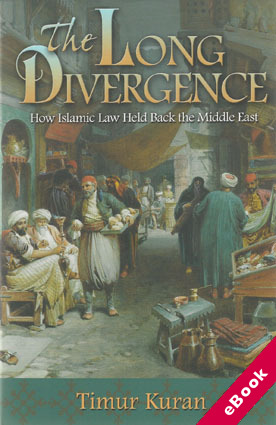
In the year 1000, the economy of the Middle East was at least as advanced as that of Europe. But by 1800, the region had fallen dramatically behind--in living standards, technology, and economic institutions. In short, the Middle East had failed to modernize economically as the West surged ahead. What caused this long divergence? And why does the Middle East remain drastically underdeveloped compared to the West?
In The Long Divergence, one of the world's leading experts on Islamic economic institutions and the economy of the Middle East provides a new answer to these long-debated questions.
Timur Kuran argues that what slowed the economic development of the Middle East was not colonialism or geography, still less Muslim attitudes or some incompatibility between Islam and capitalism. Rather, starting around the tenth century, Islamic legal institutions, which had benefitted the Middle Eastern economy in the early centuries of Islam, began to act as a drag on development by slowing or blocking the emergence of central features of modern economic life--including private capital accumulation, corporations, large-scale production, and impersonal exchange.
By the nineteenth century, modern economic institutions began to be transplanted to the Middle East, but its economy has not caught up. And there is no quick fix today. Low trust, rampant corruption, and weak civil societies--all characteristic of the region's economies today and all legacies of its economic history--will take generations to overcome.
The Long Divergence opens up a frank and honest debate on a crucial issue that even some of the most ardent secularists in the Muslim world have hesitated to discuss.










