
The eBooks we sell are sold as a single-user licence and are intended for the end user only.
The sale of some eBooks are restricted to certain countries. To alert you to such restrictions, please select the country of the billing address of your credit or debit card you wish to use for payment.
For further information see https://www.wildy.com/ebook-formats
Once the order is confirmed an e-mail will be sent to you to allow you to download the eBook. For UK purchases this will be automatic. For purchases outside the UK a member of staff will need to confirm the sale. (Staff are available to do this during normal business hours, Mon-Fri 8:30-17:00 UK time)
All eBooks are supplied firm sale and cannot be returned. If you believe there is a fault with your eBook then contact us on ebooks@wildy.com and we will help in resolving the issue. This does not affect your statutory rights.
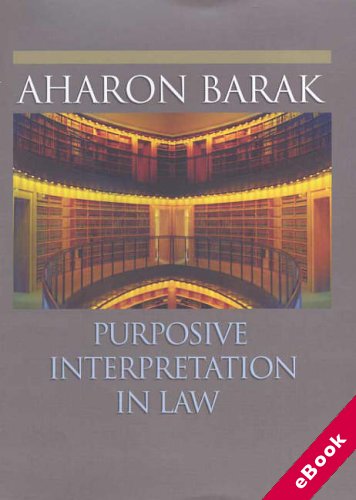
This book presents a comprehensive theory of legal interpretation, by a leading judge and legal theorist. Currently, different theories of interpretation are applied to constitutions, statutes, rules, wills, and contracts. Aharon Barak argues that what he calls "purposive interpretation" allows jurists and scholars to approach all legal texts in a similar manner while remaining sensitive to important differences.
As Barak explains, the criterion for establishing which of the semantic meanings of a given text equates with the legal meaning is the text's "purpose." Establishing the ultimate purpose - and thus the legal meaning - depends on the relationship between the subjective and objective purposes; that is, between the original intent of the text's author and the intent of a reasonable author and of the legal system at the time of interpretation.
Determining this is easy when the subjective and objective purposes coincide. But when they don't, the relative weight given to each purpose depends on the text. For example, subjective purpose is given more weight in interpreting a will; objective purpose, in interpreting a constitution. Barak develops this theory with masterful scholarship and close attention to its practical application. Throughout, he contrasts his approach with those of other leading jurists such as Antonin Scalia, Richard Posner, and Ronald Dworkin.










