
The eBooks we sell are sold as a single-user licence and are intended for the end user only.
The sale of some eBooks are restricted to certain countries. To alert you to such restrictions, please select the country of the billing address of your credit or debit card you wish to use for payment.
For further information see https://www.wildy.com/ebook-formats
Once the order is confirmed an e-mail will be sent to you to allow you to download the eBook. For UK purchases this will be automatic. For purchases outside the UK a member of staff will need to confirm the sale. (Staff are available to do this during normal business hours, Mon-Fri 8:30-17:00 UK time)
All eBooks are supplied firm sale and cannot be returned. If you believe there is a fault with your eBook then contact us on ebooks@wildy.com and we will help in resolving the issue. This does not affect your statutory rights.
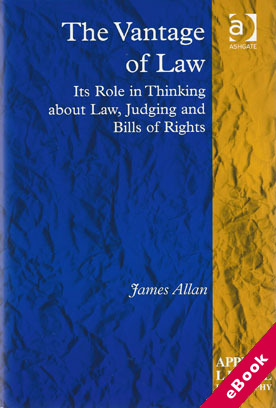
The premise of this book is that a shift of vantage will help elucidate various important issues of law related to judging, to bills of rights and to more abstract questions of legal philosophy.
This work begins by focussing on the jurisprudential issue of whether it is desirable to keep separate the demands of law and of morality and uses the device of changing vantages to elucidate the many issues that fall under that aegis.
This is followed by a consideration of how judges ought to do their job when interpreting and whether the rule of law ideal differs from rule by judges. The last part of the book focuses explicitly on bills of rights. Building on the earlier parts, the author uses his device of shifting vantages to provide insights into how these instruments affect democratic decision-making and from which perspectives they will look attractive and unattractive.
Written in a clear, accessible and engaging style, this book demonstrates that vantage point is a key criterion affecting how one understands and evaluates, firstly, some of the theoretical debates in jurisprudence and then, secondly, what judges are doing and whether a bill of rights is desirable or not.










