
Wildy Logo
(020) 7242 5778
enquiries@wildy.com

Book of the Month

Cover of Housing Law Handbook

Housing Law Handbook

Price: £85.00

Planning Law:
A Practitioner's
Handbook 2nd ed


 William Webster, Robert Weatherley


Welcome to Wildys

Watch


Corporate Insolvency Practice:
Litigation, Procedure
and Precedents 3rd ed


 Mark Watson-Gandy


Offers for Newly Called Barristers & Students

Special Discounts for Newly Called & Students

Read More ...


Secondhand & Out of Print

Browse Secondhand Online

Read More...


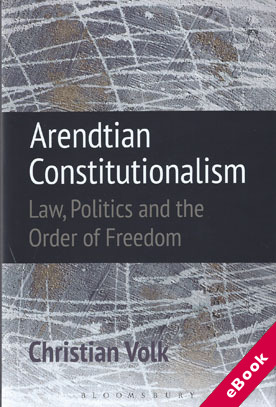
Arendtian Constitutionalism: Law, Politics and the Order of Freedom (eBook)


ISBN13: 9781509901586
Published: July 2015
Publisher: Hart Publishing
Country of Publication: UK
Format: eBook (ePub)
Price: Out of print
The amount of VAT charged may change depending on your location of use.

The eBooks we sell are sold as a single-user licence and are intended for the end user only.
The sale of some eBooks are restricted to certain countries. To alert you to such restrictions, please select the country of the billing address of your credit or debit card you wish to use for payment.

For further information see https://www.wildy.com/ebook-formats


Once the order is confirmed an e-mail will be sent to you to allow you to download the eBook. For UK purchases this will be automatic. For purchases outside the UK a member of staff will need to confirm the sale. (Staff are available to do this during normal business hours, Mon-Fri 8:30-17:00 UK time)

All eBooks are supplied firm sale and cannot be returned. If you believe there is a fault with your eBook then contact us on ebooks@wildy.com and we will help in resolving the issue. This does not affect your statutory rights.

This eBook is available in the following formats: ePub.


Due to a technical issue some ebooks are not available to order.


Need help with ebook formats?


Also available as

The meaning and function of law in Hannah Arendt’s work has never been the subject of a systematic reconstruction.

This book examines Arendt’s work and reconstructs her ideas through political, legal and constitutional theory, and shows that her engagement with law is continuous as well as crucial to an adequate understanding of her political thought.

The author argues that Arendt was very much concerned with the question of an adequate arrangement of law, politics and order – the so-called triad of constitutionalism – and considers suitable forms for the institutionalisation of conflict-ridden political action. By adopting this approach, the author suggests an alternative interpretation of Arendt’s thought, which sees Arendt as neither the advocate of ancient political forms, such as Aristotelian communitarianism, nor as a subscriber to the discourse-theoretical or agonal reading of her thought.

In the author’s view, Arendt is a thinker of political order who is concerned with the importance of a stable and free political order in which political struggle and dissent can freely occur.


Subjects:
Jurisprudence, eBooks
Contents:
Introduction

1. The Paradoxes of the Nation-State
I. Introduction
II. The Paradox of the Right to Self-determination
III. The Paradox of De-assimilation and De-naturalisation
IV. The Paradox of Rightlessness
V. The Paradox of Human Rights

2. The Concept of the Nation in Hannah Arendt's Thought
I. Introduction
II. Arendt and the Social Question - A Political-theoretical Readjustment
A. Revolution and Discourse
B. Sovereignty and Misery C. Misery and Consensus
III. The Concept of the Nation and the Volonte Generale
A. Arendt, Rousseau and the French Revolution
B. General Will and Alienation
C. The Internalisation of the Political

3. Law and the Modern State - Hannah Arendt on the Trail of Max Weber
I. Introduction
A. In Which Line of Tradition to Think About the State? Neither Hegel nor Elias
B. An Initial Plea for Max Weber
II. On the Origin of the Modern State
A. State and Modern State in Weber
B. Arendt and the Genealogy of the Modern State
III. On the Rationality of Law
A. What is Rational Law? A Look at Weber's Sociology of Law
B. Arendt and Rational Law

4. Hannah Arendt's Critique of Popular Sovereignty
I. Introduction
II. Popular Sovereignty and the Law
A. The Political-theoretical Architecture of Arendt's book on Totalitarianism
B. Arendt and the Sources of Juridification
C. Nation and Law
III. Popular Sovereignty and Politics
A. Politics in Mass Society
B. Mistrust and Authority
C. Mass Movement and Power

5. The Order of Freedom: On the Dehierarchisation of the Relationship Between Law and Politics
I. Introduction
II. Arendt's Understanding of the Political
A. Arendt and the Normativity of the Political
B. From the Power of Judgement to the Procedural Rules of the Political System
III. Arendt's Theory of Law
A. The Concept of Law: Relationship versus Substance
B. What is Legitimate Law?
C. Arendt's Demanding Concept of Political Enabling









