
The eBooks we sell are sold as a single-user licence and are intended for the end user only.
The sale of some eBooks are restricted to certain countries. To alert you to such restrictions, please select the country of the billing address of your credit or debit card you wish to use for payment.
For further information see https://www.wildy.com/ebook-formats
Once the order is confirmed an e-mail will be sent to you to allow you to download the eBook. For UK purchases this will be automatic. For purchases outside the UK a member of staff will need to confirm the sale. (Staff are available to do this during normal business hours, Mon-Fri 8:30-17:00 UK time)
All eBooks are supplied firm sale and cannot be returned. If you believe there is a fault with your eBook then contact us on ebooks@wildy.com and we will help in resolving the issue. This does not affect your statutory rights.
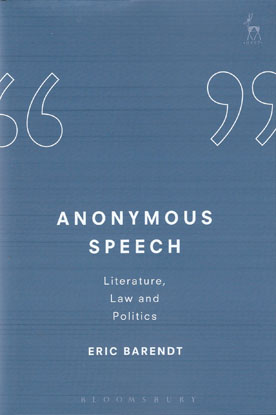
Anonymous Speech: Literature, Law and Politics discusses the different contexts in which people write anonymously or with the use of a pseudonym: novels and literary reviews, newspapers and political periodicals, graffiti, and now on the Internet.
The book criticises the arguments made for a strong constitutional right to anonymous speech, though it agrees that there is a good case for anonymity in some circumstances, notably for whistle-blowing. One chapter examines the general treatment of anonymous speech and writing in English law, while another is devoted to the protection of journalists' sources, where the law upholds a freedom to communicate anonymously through the media.
A separate chapter looks at anonymous Internet communication, particularly on the social media, and analyses the difficulties faced by the victims of threats and defamatory allegations on the Net when the speaker has used a pseudonym. In its final chapter the book compares the universally accepted argument for the secret ballot with the more controversial case for anonymous speech.
This is the first comprehensive study of anonymous speech to examine critically the arguments for and against anonymity. These arguments were vigorously canvassed in the nineteenth century - largely in the context of literary reviewing - and are now of enormous importance for communication on the Internet.











