
The eBooks we sell are sold as a single-user licence and are intended for the end user only.
The sale of some eBooks are restricted to certain countries. To alert you to such restrictions, please select the country of the billing address of your credit or debit card you wish to use for payment.
For further information see https://www.wildy.com/ebook-formats
Once the order is confirmed an e-mail will be sent to you to allow you to download the eBook. For UK purchases this will be automatic. For purchases outside the UK a member of staff will need to confirm the sale. (Staff are available to do this during normal business hours, Mon-Fri 8:30-17:00 UK time)
All eBooks are supplied firm sale and cannot be returned. If you believe there is a fault with your eBook then contact us on ebooks@wildy.com and we will help in resolving the issue. This does not affect your statutory rights.
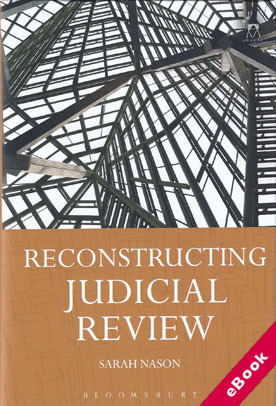
This book offers a new interpretation of judicial review in England and Wales that is developed both from examining the functions and values that ought to be served by judicial review, and from analysis of empirical 'social' facts about judicial review primarily as experienced in the Administrative Court.
Based on ground-up case law analysis it constructs a new taxonomy of the grounds of judicial review: mistake, procedural impropriety, ordinary common law statutory interpretation, discretionary impropriety relevant/irrelevant considerations, breach of an ECHR protected right orequality duty, and constitutional allocation of powers, constitutional rights, or other complex constitution principles.
It explains each of these grounds, what academic and judicial support there might be for them outside case law analysis, and their similarities and differences when viewed against popular existing taxonomies.
It concludes that Administrative Court judges are engaged in ordinary common law statutory interpretation in approximately half of all cases, and that where discretionary judgment is involved on the part of the initial decision-maker, judges do indeed consider their task to be one of determining whether the challenged decision was justified by reasoning of adequate quality.
It finds that judges apply ordinary common law principles of statutory interpretation with historical pedigrees; including assessing the initial decision-maker's reasoning with reference to statutory purpose, and sifting relevant from irrelevant considerations, including moral considerations.
The result is a ground-breaking reassessment of the grounds of judicial review in England and Wales and the practice of the Administrative Court.











