
Wildy Logo
(020) 7242 5778
enquiries@wildy.com

Book of the Month

Cover of Housing Law Handbook

Housing Law Handbook

Price: £85.00

Planning Law:
A Practitioner's
Handbook 2nd ed


 William Webster, Robert Weatherley


Welcome to Wildys

Watch


Corporate Insolvency Practice:
Litigation, Procedure
and Precedents 3rd ed


 Mark Watson-Gandy


Offers for Newly Called Barristers & Students

Special Discounts for Newly Called & Students

Read More ...


Secondhand & Out of Print

Browse Secondhand Online

Read More...


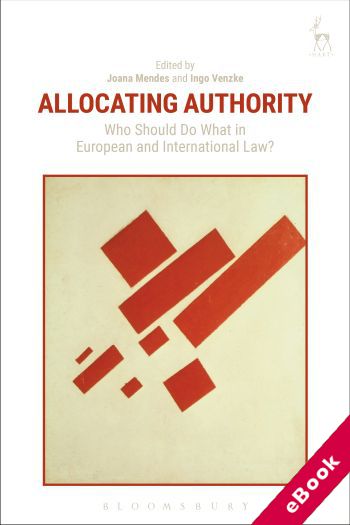
Allocating Authority: Who Should Do What in European and International Law? (eBook)

Edited by: Joana Mendes, Ingo Venzke

ISBN13: 9781509911929
Published: January 2018
Publisher: Hart Publishing
Country of Publication: UK
Format: eBook (ePub)
Price: Out of print
The amount of VAT charged may change depending on your location of use.

The eBooks we sell are sold as a single-user licence and are intended for the end user only.
The sale of some eBooks are restricted to certain countries. To alert you to such restrictions, please select the country of the billing address of your credit or debit card you wish to use for payment.

For further information see https://www.wildy.com/ebook-formats


Once the order is confirmed an e-mail will be sent to you to allow you to download the eBook. For UK purchases this will be automatic. For purchases outside the UK a member of staff will need to confirm the sale. (Staff are available to do this during normal business hours, Mon-Fri 8:30-17:00 UK time)

All eBooks are supplied firm sale and cannot be returned. If you believe there is a fault with your eBook then contact us on ebooks@wildy.com and we will help in resolving the issue. This does not affect your statutory rights.

This eBook is available in the following formats: ePub.


Due to a technical issue some ebooks are not available to order.


Need help with ebook formats?


Also available as

The question of which European and international institutions get to exercise public authority is a hugely contested one. This important new collection offers an innovative approach to the question by arguing that by viewing such authority as relative, it allows for greater understanding of both the allocation and its legitimacy. Furthermore, it argues that relations between actors should reflect the comparative analysis of the legitimacy assets that each actor can bring into the process of governance. Put succinctly, it illustrates that public authority is relative between actors and relative to specific legitimacy assets.

Drawing on the expertise of leading scholars in the field, Allocating Authority offers a thought-provoking and rigorous analysis of this long debated question.


Subjects:
Public International Law, EU Law, eBooks
Contents:
1. Introducing the Idea of Relative Authority
Joana Mendes and Ingo Venzke

Part I: Empirical and Normative Traction
2. Democratic Legitimacy and Executive Rule-making: Positive Political Theory in Comparative Public Law
Susan Rose-Ackerman
3. In Search of a New Model of Checks and Balances for the EU: Beyond Separation of Powers
Eoin Carolan and Deirdre Curtin
4. Bolstering Authority by Enhancing Communication: How Checks and Balances and Feedback Loops can Strengthen the Authority of the European Court of Human Rights
Mikael Rask Madsen
5. Authority Monism in International Organisations: A Historical Sketch
Jochen von Bernstorff
6. No Institution is an Island: Checks and Balances in Global Governance
Andreas von Staden

Part II: Iterations in Practice
7. The Role of the Court of Justice in Shaping the Institutional Balance in the EU
Bruno De Witte
8. Refining Relative Authority: The Judicial Branch in the New Separation of Powers
Joseph Corkin
9. Judicial Review of EU Administrative Discretion: How Far Does the Separation of Powers Matter?
Dominique Ritleng
10. First or Second Best? Judicial Law-making in European Private Law
Chantal Mak
11. Relative Authority in Global and EU Financial Regulation: Linking the Legitimacy Debates
Maurizia De Bellis
12. Relative Authority and Institutional Decision-making in World Trade Law and International Investment Law
Diane A Desierto"







