
The eBooks we sell are sold as a single-user licence and are intended for the end user only.
The sale of some eBooks are restricted to certain countries. To alert you to such restrictions, please select the country of the billing address of your credit or debit card you wish to use for payment.
For further information see https://www.wildy.com/ebook-formats
Once the order is confirmed an e-mail will be sent to you to allow you to download the eBook. For UK purchases this will be automatic. For purchases outside the UK a member of staff will need to confirm the sale. (Staff are available to do this during normal business hours, Mon-Fri 8:30-17:00 UK time)
All eBooks are supplied firm sale and cannot be returned. If you believe there is a fault with your eBook then contact us on ebooks@wildy.com and we will help in resolving the issue. This does not affect your statutory rights.
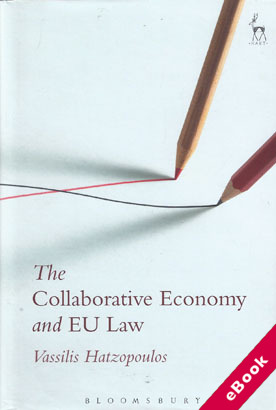
“Disruptive innovation”, “the fourth industrial revolution”, “one of the ten ideas that will change the world”; the collaborative/sharing economy is shaking existing norms. It poses unprecedented challenges in terms of both material policies and governance in almost all aspects of EU law.
This book explores the application – or indeed inadequacy - of existing EU rules in the context of the collaborative economy. It analyses the novelties introduced by the collaborative economy and discusses the specific regulatory needs and instruments employed therein, most notably self-regulation. Further, it aims to elucidate the legal status of the parties involved (traders, consumers, prosumers) in these multi-sided economies, and their respective roles in the provision of services, especially with regard to liability issues.
Moreover, it delves into a sector-specific examination of the relevant EU rules, especially on data protection, competition, consumer protection and labour law, and comments on the uncertainties and lacunae produced therein. It concludes with the acute question whether fresh EU regulation would be necessary to avoid fragmentation or, on the contrary, it would create unnecessary burdens and stifle innovation.
Taking a broad perspective and pragmatic view, the book provides a comprehensive overview of the collaborative economy in the context of the EU legal landscape.










