
The eBooks we sell are sold as a single-user licence and are intended for the end user only.
The sale of some eBooks are restricted to certain countries. To alert you to such restrictions, please select the country of the billing address of your credit or debit card you wish to use for payment.
For further information see https://www.wildy.com/ebook-formats
Once the order is confirmed an e-mail will be sent to you to allow you to download the eBook. For UK purchases this will be automatic. For purchases outside the UK a member of staff will need to confirm the sale. (Staff are available to do this during normal business hours, Mon-Fri 8:30-17:00 UK time)
All eBooks are supplied firm sale and cannot be returned. If you believe there is a fault with your eBook then contact us on ebooks@wildy.com and we will help in resolving the issue. This does not affect your statutory rights.
The last decade has witnessed an increasing focus on the impact of climate change on the enjoyment of human rights.
Several international human rights bodies have now recognised the negative implications of climate change for the enjoyment of the rights to life, food, health, housing and self-determination, among others, and regularly call on states to ensure the participation of women, indigenous peoples and other vulnerable groups in climate change-related actions.
Yet despite this, there are still significant gaps in our understanding of the role of international human rights law in enhancing accountability for actions related to climate change.
While accountability is central to human rights law and practice, in the context of climate change it has been undermined by a lack of clarity regarding a series of legal and practical questions. Other pressing questions are the relationship between international human rights law and the UNFCCC regime, and to what extent human rights bodies are competent to deal with cases related to climate change.
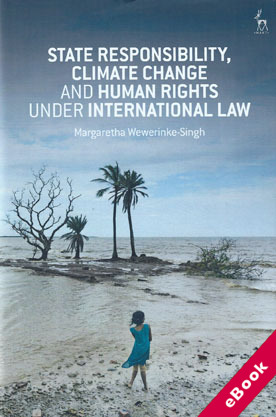
This book offers a timely and comprehensive analysis of the issues related to accountability for the human rights impact of climate change, drawing on the state responsibility regime.










