
The eBooks we sell are sold as a single-user licence and are intended for the end user only.
The sale of some eBooks are restricted to certain countries. To alert you to such restrictions, please select the country of the billing address of your credit or debit card you wish to use for payment.
For further information see https://www.wildy.com/ebook-formats
Once the order is confirmed an e-mail will be sent to you to allow you to download the eBook. For UK purchases this will be automatic. For purchases outside the UK a member of staff will need to confirm the sale. (Staff are available to do this during normal business hours, Mon-Fri 8:30-17:00 UK time)
All eBooks are supplied firm sale and cannot be returned. If you believe there is a fault with your eBook then contact us on ebooks@wildy.com and we will help in resolving the issue. This does not affect your statutory rights.
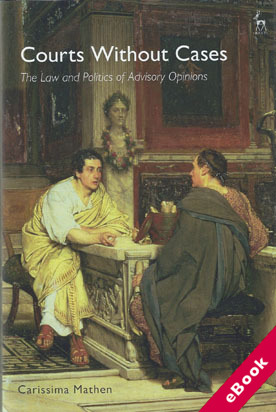
In Canada since 1875, courts have been permitted to act as advisors alongside their ordinary, adjudicative role. This book offers the first detailed examination of that role from a legal perspective.
When one thinks of courts, it is most often in the context of deciding cases: live disputes involving spirited, adversarial debate between opposing parties. Sometimes, though, a court is granted the power to answer questions in the absence of cases through a reference or advisory opinions. These proceedings raise many questions: about the judicial role, about the relationship between courts and those who seek their “advice”, and about the nature of law.
Tracking their use in Canada since the country’s Confederation and looking to the experience in other legal systems, this book considers how reference opinions draw courts into the complex relationship between law and politics.
Focusing on key themes such as the separation of powers, federalism, rights and precedent, this book provides an important and timely study of a fascinating phenomenon.











