
The eBooks we sell are sold as a single-user licence and are intended for the end user only.
The sale of some eBooks are restricted to certain countries. To alert you to such restrictions, please select the country of the billing address of your credit or debit card you wish to use for payment.
For further information see https://www.wildy.com/ebook-formats
Once the order is confirmed an e-mail will be sent to you to allow you to download the eBook. For UK purchases this will be automatic. For purchases outside the UK a member of staff will need to confirm the sale. (Staff are available to do this during normal business hours, Mon-Fri 8:30-17:00 UK time)
All eBooks are supplied firm sale and cannot be returned. If you believe there is a fault with your eBook then contact us on ebooks@wildy.com and we will help in resolving the issue. This does not affect your statutory rights.
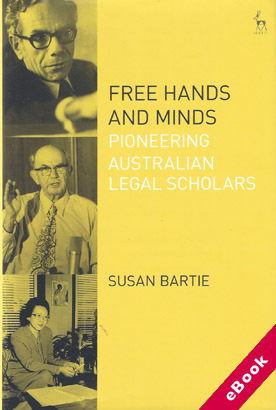
Peter Brett (1918-1975), Alice Erh-Soon Tay (1934-2004) and Geoffrey Sawer (1910-1996) are key, yet largely overlooked, members of Australia’s first community of legal scholars.
This book is a critical study of how their ideas and endeavours contributed to Australia’s discipline of law and the first Australian legal theories. It examines how three marginal figures—a Jewish man (Brett), a Chinese woman (Tay), and a war orphan (Sawer)—rose to prominence during a transformative period for Australian legal education and scholarship.
Drawing on in-depth interviews with former colleagues and students, extensive archival research, and an appraisal of their contributions to scholarship and teaching, this book explores the three professors’ international networks and broader social and historical milieux. Their pivotal leadership roles in law departments at the University of Melbourne, University of Sydney, and the Australian National University are also critically assessed.
Deftly ranging from local experiences and the concerns of a nascent Australian legal academy to the complex transnational phenomena of legal scholarship and theory, it makes a compelling case for contextualising law and legal culture within society. At a time of renewed crisis in legal education and research in the common law world, it also offers a vivid, nuanced and critical account of the enduring liberal foundations of Australia’s discipline of law.










