
Wildy Logo
(020) 7242 5778
enquiries@wildy.com

Book of the Month

Cover of Housing Law Handbook

Housing Law Handbook

Price: £85.00

Planning Law:
A Practitioner's Handbook
2nd ed


 William Webster, Robert Weatherley


Welcome to Wildys

Watch


Judicial Cooperation in Commercial Litigation 3rd ed (The British Cross-Border Financial Centre World)


 Ian Kawaley, David Doyle, Shade Subair Williams


Offers for Newly Called Barristers & Students

Special Discounts for Newly Called & Students

Read More ...


Secondhand & Out of Print

Browse Secondhand Online

Read More...


Sorry. Can't find the title you are looking for.

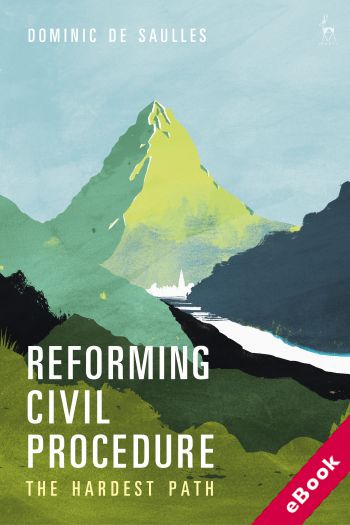
Reforming Civil Procedure: The Hardest Path (eBook)


ISBN13: 9781509925926
Published: May 2019
Publisher: Hart Publishing
Country of Publication: UK
Format: eBook (ePub)
Price: Out of print
The amount of VAT charged may change depending on your location of use.

The eBooks we sell are sold as a single-user licence and are intended for the end user only.
The sale of some eBooks are restricted to certain countries. To alert you to such restrictions, please select the country of the billing address of your credit or debit card you wish to use for payment.

For further information see https://www.wildy.com/ebook-formats


Once the order is confirmed an e-mail will be sent to you to allow you to download the eBook. For UK purchases this will be automatic. For purchases outside the UK a member of staff will need to confirm the sale. (Staff are available to do this during normal business hours, Mon-Fri 8:30-17:00 UK time)

All eBooks are supplied firm sale and cannot be returned. If you believe there is a fault with your eBook then contact us on ebooks@wildy.com and we will help in resolving the issue. This does not affect your statutory rights.

This eBook is available in the following formats: ePub.


Due to a technical issue some ebooks are not available to order.


Need help with ebook formats?


Also available as

Drawing on political, social and economic theory, this book focuses on the English civil justice system, looking at its history and its processes. It considers its objectives and how it operates for and against particular societal groups, and what ideas and behaviours impact it.

The reform of civil procedure has been beset with difficulties. Some are caused by questions of culture and mind-sets resistant to the changes, some by a confusion and conflict of values, some by overambitious reform efforts, some by a failure to follow through on purpose clauses, and some by swinging from laxity to rigidity with insufficient analysis.

This book makes a strong contribution to the field by synthesising the work of English writers with different views, extending the work in England on the role of philosophy, values, process, and culture in litigation and engaging extensively with American writers who have not previously been the subject of much attention in English civil procedural studies.


Subjects:
eBooks, Courts and Procedure
Contents:
History: America to 1938
1. Purposes and Functions
I. The Need for Theory
II. Complexity and Intertwining
III. The Function of Civil Procedure
IV. Society and the Courts
V. The Social World
VI. Pragmatism
VII. Management and Justice
VIII. The Function of the English Civil Justice System
IX. Reading the Rules
X. Conclusion
2. What is Civil Procedure For?
I. American Themes and Perspectives
II. English Themes and Perspectives
3. Intention, Action and Outcome in Anglo-American Civil Procedure
I. The Rules of the Supreme Court (1883 and 1965)
II. The Federal Rules of Civil Procedure (1938)
III. The Civil Procedure Rules 1998
4. Voyages in a New World: The Unanticipated Consequences of Civil Justice Reform
I. Introduction
II. History and a New Paradigm
5. Defending the Civil Justice System: The Function of Sanctions
I. Introduction
II. Systems
III. Analysis of Sanctions
IV. Reform of Sanctions
6. Process Costs and Error Costs: The Reform of Civil Appeals in Anglo-American Perspective
I. Introduction
II. Policy, Practicality and Proportionality
III. First Appeals – The New Regime
IV. Second Appeals – The New Regime







