
The eBooks we sell are sold as a single-user licence and are intended for the end user only.
The sale of some eBooks are restricted to certain countries. To alert you to such restrictions, please select the country of the billing address of your credit or debit card you wish to use for payment.
For further information see https://www.wildy.com/ebook-formats
Once the order is confirmed an e-mail will be sent to you to allow you to download the eBook. For UK purchases this will be automatic. For purchases outside the UK a member of staff will need to confirm the sale. (Staff are available to do this during normal business hours, Mon-Fri 8:30-17:00 UK time)
All eBooks are supplied firm sale and cannot be returned. If you believe there is a fault with your eBook then contact us on ebooks@wildy.com and we will help in resolving the issue. This does not affect your statutory rights.
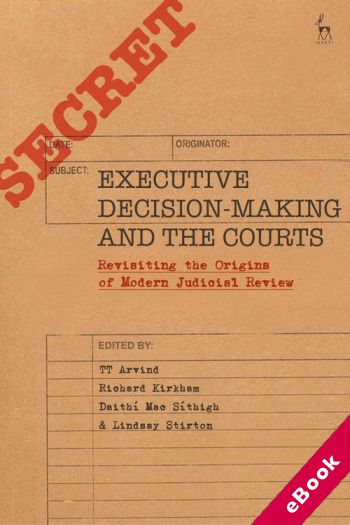
In this book, leading experts from across the common law world assess the impact of four seminal House of Lords judgments decided in the 1960s: Ridge v Baldwin, Padfeld v Minister of Agriculture, Conway v Rimmer, and Anisminic v Foreign Compensation Commission. The 'Quartet' is generally acknowledged to have marked a turning point in the development of court-centred administrative law, and can be understood as a 'formative moment' in the emergence of modern judicial review.
These cases are examined not only in terms of the points each case decided, and their contribution to administrative law doctrine, but also in terms of the underlying conception of the tasks of administrative law implicit in the Quartet. By doing so, the book sheds new light on both the complex processes through which the modern system of judicial review emerged and the constitutional choices that are implicit in its jurisprudence. It further reflects upon the implications of these historical processes for how the achievements, failings and limitations of the common law in reviewing actions of the executive can be evaluated.










