
The eBooks we sell are sold as a single-user licence and are intended for the end user only.
The sale of some eBooks are restricted to certain countries. To alert you to such restrictions, please select the country of the billing address of your credit or debit card you wish to use for payment.
For further information see https://www.wildy.com/ebook-formats
Once the order is confirmed an e-mail will be sent to you to allow you to download the eBook. For UK purchases this will be automatic. For purchases outside the UK a member of staff will need to confirm the sale. (Staff are available to do this during normal business hours, Mon-Fri 8:30-17:00 UK time)
All eBooks are supplied firm sale and cannot be returned. If you believe there is a fault with your eBook then contact us on ebooks@wildy.com and we will help in resolving the issue. This does not affect your statutory rights.
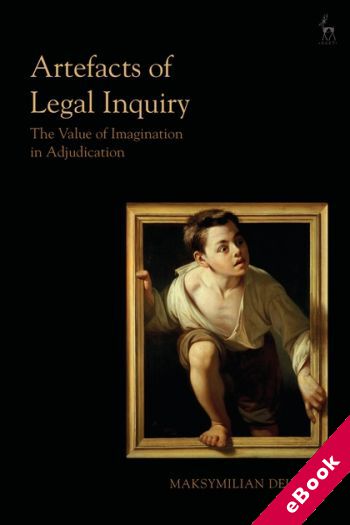
What is the role and value of legal fictions, metaphors, hypothetical narratives and personification in legal thought? This book develops a theoretical framework to answer that question. Legal language, it is argued, contains artefacts - fabricated forms that capture our attention by signaling their own artifice and invite us to imagine. To imagine, in turn, is to enter into a distinct epistemic frame where we temporarily suspend certain epistemic commitments and participate actively along a spectrum of affective, sensory and kinetic involvement.
The artefacts of legal language and related processes of imagination are crucial to legal thought at many levels, including the level of the individual judge, the level of interaction in the courtroom, and the level of the resourcefulness of law over time. Drawing on a broad range of theoretical traditions - including philosophy of imagination and emotion, the theory and history of rhetoric, and cognitive literary studies - this book offers an interdisciplinary model and defence of the importance of imagination in adjudication. The book also situates the model of artefacts and related processes of imagination in the history of twentieth century theories of legal reasoning and offers resources and activities for the education of imagination in law schools.










