
The eBooks we sell are sold as a single-user licence and are intended for the end user only.
The sale of some eBooks are restricted to certain countries. To alert you to such restrictions, please select the country of the billing address of your credit or debit card you wish to use for payment.
For further information see https://www.wildy.com/ebook-formats
Once the order is confirmed an e-mail will be sent to you to allow you to download the eBook. For UK purchases this will be automatic. For purchases outside the UK a member of staff will need to confirm the sale. (Staff are available to do this during normal business hours, Mon-Fri 8:30-17:00 UK time)
All eBooks are supplied firm sale and cannot be returned. If you believe there is a fault with your eBook then contact us on ebooks@wildy.com and we will help in resolving the issue. This does not affect your statutory rights.
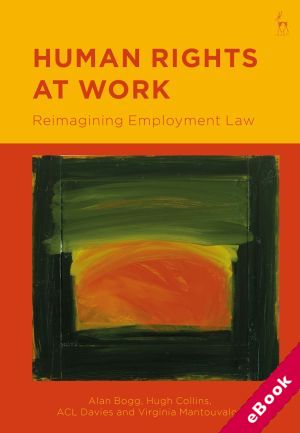
Should workers ever lose their job because of their political views or affiliations? Should female employees be entitled to wear a headscarf in the workplace for religious reasons? Can it ever be right for an employer to dismiss someone for personal activities undertaken in their leisure time? What restrictions, if any, should be placed on the right to strike?
Engagingly written, this innovative new textbook provides an entry point for exploring these and other topical issues, enabling students to analyse the applicability of human rights to disputes between employers and workers in the UK. It offers an original perspective on the traditional topics of employment law as well as looking in greater depth at new issues, such as employees' use of social media or the enforcement of human rights in the gig economy.
Uniquely, the book considers the most important international Conventions that are relevant for the law in the UK, especially the European Convention on Human Rights, the European Social Charter, Conventions of the International Labour Organisation, and the Charter of Fundamental Rights of the European Union.
A central question that each of the chapters addresses is whether UK employment law is compatible with human rights law. Each chapter discusses all the key cases drawn from various jurisdictions, including the Court of Justice of the European Union and the European Court of Human Rights.
Written by a stellar team of authors, this textbook is an invaluable teaching aid for both postgraduate and undergraduate students studying employment law, human rights, human resource management, and industrial relations.










