
The eBooks we sell are sold as a single-user licence and are intended for the end user only.
The sale of some eBooks are restricted to certain countries. To alert you to such restrictions, please select the country of the billing address of your credit or debit card you wish to use for payment.
For further information see https://www.wildy.com/ebook-formats
Once the order is confirmed an e-mail will be sent to you to allow you to download the eBook. For UK purchases this will be automatic. For purchases outside the UK a member of staff will need to confirm the sale. (Staff are available to do this during normal business hours, Mon-Fri 8:30-17:00 UK time)
All eBooks are supplied firm sale and cannot be returned. If you believe there is a fault with your eBook then contact us on ebooks@wildy.com and we will help in resolving the issue. This does not affect your statutory rights.
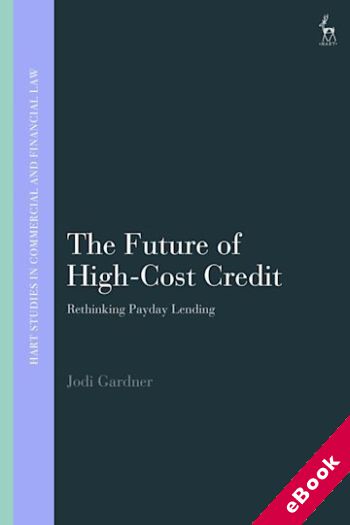
This book proposes a new way of thinking about the controversial and complex challenges associated with the regulation of high-cost credit, specifically payday lending. These products have received significant attention in both the media and political arena. The inadequacy of regulatory interventions has created ongoing problems with the provision of high-cost credit, particularly for consumers with lesser bargaining power and who are already financially vulnerable.
The book tackles two specific gaps in the existing literature. The first involves inadequate analysis of the relevant philosophical concepts around high-cost credit, which can result in an over-simplification of what are particularly complex issues. The second is a lack of engagement in both the market and lived experience of borrowers, resulting in limited understanding of those who use these financial products.
The Future of High-Cost Credit explores the theoretical grounding, policy initiatives and interdisciplinary perspectives associated with high-cost credit, making a novel and insightful contribution to the existing literature. The problems with debt extend far beyond the legal sphere, and the book will therefore be of interest to many other academic disciplines, as well as for those working in public policy and 'the third sector'.










