
The eBooks we sell are sold as a single-user licence and are intended for the end user only.
The sale of some eBooks are restricted to certain countries. To alert you to such restrictions, please select the country of the billing address of your credit or debit card you wish to use for payment.
For further information see https://www.wildy.com/ebook-formats
Once the order is confirmed an e-mail will be sent to you to allow you to download the eBook. For UK purchases this will be automatic. For purchases outside the UK a member of staff will need to confirm the sale. (Staff are available to do this during normal business hours, Mon-Fri 8:30-17:00 UK time)
All eBooks are supplied firm sale and cannot be returned. If you believe there is a fault with your eBook then contact us on ebooks@wildy.com and we will help in resolving the issue. This does not affect your statutory rights.
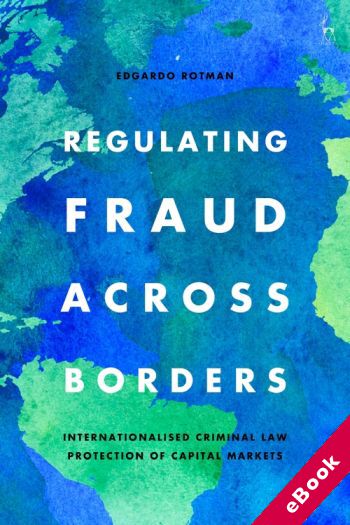
At a time when financial crime routinely crosses international boundaries, this book provides a novel understanding of its spread and criminalisation. It traces the international convergence of financial crime regulation with a uniquely comparative approach that examines key institutional and state actors including the European Union, the International Organization of Securities Commissions, as well as the United States, the United Kingdom, Switzerland, France, Italy and Germany, all countries that harbour some of the most influential stock exchanges in the Western world.
The book describes and documents the phenomenon of internationalisation of securities frauds – such as insider trading and market manipulation – and the laws criminalising those acts, most notably those responding to recent dramatic transformations in securities markets, high frequency trading, and benchmark manipulation. At the European level, it shows the progressive uniformisation of laws culminating in the 2014 European Union Market Abuse Regulation.
The book argues that criminal prohibitions against internationalised market abuse must be understood as an economic and legal imperative to protect financial markets against activities that imperil its integrity, compromising the confidence of investors and thus affecting the economy as a whole. The book is supported by an extensive review of the most significant scholarship in each country.










