
The eBooks we sell are sold as a single-user licence and are intended for the end user only.
The sale of some eBooks are restricted to certain countries. To alert you to such restrictions, please select the country of the billing address of your credit or debit card you wish to use for payment.
For further information see https://www.wildy.com/ebook-formats
Once the order is confirmed an e-mail will be sent to you to allow you to download the eBook. For UK purchases this will be automatic. For purchases outside the UK a member of staff will need to confirm the sale. (Staff are available to do this during normal business hours, Mon-Fri 8:30-17:00 UK time)
All eBooks are supplied firm sale and cannot be returned. If you believe there is a fault with your eBook then contact us on ebooks@wildy.com and we will help in resolving the issue. This does not affect your statutory rights.
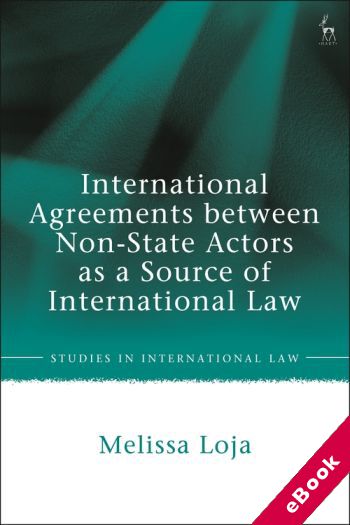
This book examines whether international agreements between non-state actors can be identified as a source of international law using objective criteria. It asks whether, beyond Article 38 of the Statute of the International Court of Justice, there is a system of rules, processes, beliefs or semantics by which these agreements can be objectively identified as a source of international law. Departing from the more usual state-centric analysis, it adopts postmodern legal positivism as its analytical tool. This allows for the reality that international law-making takes place in subjective social landscapes.
To test the effectiveness of this approach, it is applied to agreements between petroleum agencies and corporations which allow two or more states to exploit disputed resources across boundaries looking in particular at arrangements involving China, Vietnam and the Philippines. By so doing it illustrates an alternative way that states can manage disputes, without having to resort to conflict. It will appeal to both scholars and practitioners of public international law, as well as civil servants.











