
The eBooks we sell are sold as a single-user licence and are intended for the end user only.
The sale of some eBooks are restricted to certain countries. To alert you to such restrictions, please select the country of the billing address of your credit or debit card you wish to use for payment.
For further information see https://www.wildy.com/ebook-formats
Once the order is confirmed an e-mail will be sent to you to allow you to download the eBook. For UK purchases this will be automatic. For purchases outside the UK a member of staff will need to confirm the sale. (Staff are available to do this during normal business hours, Mon-Fri 8:30-17:00 UK time)
All eBooks are supplied firm sale and cannot be returned. If you believe there is a fault with your eBook then contact us on ebooks@wildy.com and we will help in resolving the issue. This does not affect your statutory rights.
Due to a technical issue some ebooks are not available to order.
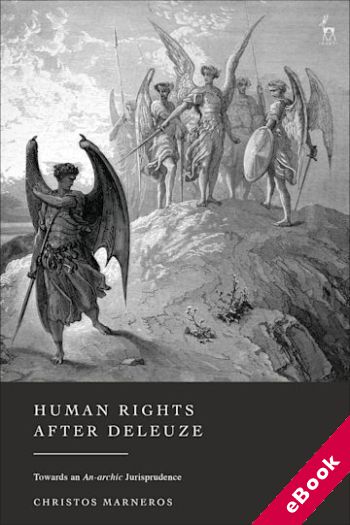
This book examines the possibility of creating new ways of existing beyond human rights. Multiple socio-political crises and the dominance of neoliberal and capitalist policies have led legal and political theorists to question the emancipatory promise of human rights and to reconceptualise human rights in theory and practice. The possibility of creating new ways of existing beyond human rights has been left significantly under examined, until now.
Having as its starting point the ferocious, yet brief, critique on human rights of one of the most prominent French philosophers of the 20th century, Gilles Deleuze, the book argues that Deleuze's critique is not only compatible with his broader thought but that it has the potential to give a new impetus to the current critiques of human rights, within the 'disciplinary borders' of legal and political theory.
The book draws upon Deleuze's broader thought, but also radical legal and political theory and continental philosophy. In particular, it investigates and expands on two of Deleuze's most important notions, namely those of 'immanence' and 'becoming' and their relation to the philosopher's critique of human rights. In doing so, it argues that these two notions are capable of questioning the dominant and dogmatic position that human rights enjoy.










