
The eBooks we sell are sold as a single-user licence and are intended for the end user only.
The sale of some eBooks are restricted to certain countries. To alert you to such restrictions, please select the country of the billing address of your credit or debit card you wish to use for payment.
For further information see https://www.wildy.com/ebook-formats
Once the order is confirmed an e-mail will be sent to you to allow you to download the eBook. For UK purchases this will be automatic. For purchases outside the UK a member of staff will need to confirm the sale. (Staff are available to do this during normal business hours, Mon-Fri 8:30-17:00 UK time)
All eBooks are supplied firm sale and cannot be returned. If you believe there is a fault with your eBook then contact us on ebooks@wildy.com and we will help in resolving the issue. This does not affect your statutory rights.
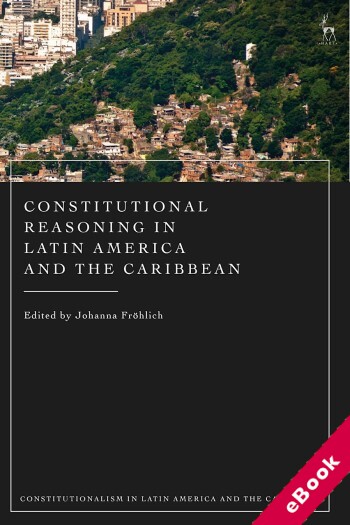
This book examines the jurisprudence of 15 constitutional courts and supreme courts, including the Caribbean Commonwealth and the Inter-American Court of Human Rights. By looking at the reason-giving practice by courts, the volume considers how Latin American courts justify their decisions, which is the precondition for constructive criticism and improvement.
Based on original data and a region-specific methodology, the book provides a systematic analysis utilising more than 600 leading cases. It shows which interpretive methods and concepts are most favoured by Latin American courts, and which courts were the most and the least prolific in their reasoning activities.
The volume traces the features of judicial dialogue on a regional and sub-regional level and enables the evaluation and comparison of each country's reasoning culture in different epochs. The collection includes diverse graphs to visualise the changes and tendencies of the reasoning practices throughout time in the region, based on information gathered from the dataset.
Latin American courts have gone through remarkable reforms after a series of constitutional changes adopted in light of the transformative constitutional trends that swept through the region in the late 1980s. The book illuminates how these courts have actually been reaching their decisions and facilitates future successful litigation strategies for both national constitutional courts and the Inter-American Court for Human Rights.This project has been possible due to the collaboration and funding provided by the Rule of Law Programme for Latin America of the Konrad Adenauer Foundation and the Law School of the University of San Francisco de Quito.










