
The eBooks we sell are sold as a single-user licence and are intended for the end user only.
The sale of some eBooks are restricted to certain countries. To alert you to such restrictions, please select the country of the billing address of your credit or debit card you wish to use for payment.
For further information see https://www.wildy.com/ebook-formats
Once the order is confirmed an e-mail will be sent to you to allow you to download the eBook. For UK purchases this will be automatic. For purchases outside the UK a member of staff will need to confirm the sale. (Staff are available to do this during normal business hours, Mon-Fri 8:30-17:00 UK time)
All eBooks are supplied firm sale and cannot be returned. If you believe there is a fault with your eBook then contact us on ebooks@wildy.com and we will help in resolving the issue. This does not affect your statutory rights.
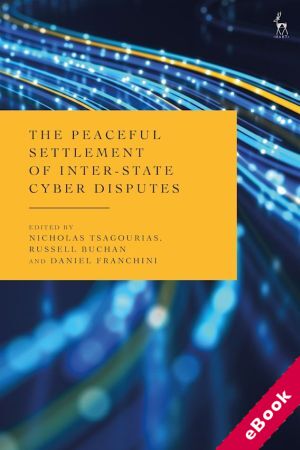
With cyberspace becoming a domain of inter-state conflict and confrontation, this book is one of the first studies of the ways in which international law can facilitate the peaceful settlement of inter-state cyber disputes.
By employing theoretical and practical inquiries and analysis, the book examines the legal parameters of cyber dispute settlement; explores critical questions about the role of dispute settlement institutions and methods; and identifies and addresses related challenges.
The book begins by considering the legal definition of a cyber dispute and the scope of the good faith obligation of states in settling their cyber disputes peacefully. It then examines the role of certain dispute settlement institutions (International Court of Justice, national courts, the EU, the Security Council) and dispute settlement methods (judicial, diplomatic, countermeasures, arbitration, conciliation, fact-finding). It also discusses how data disputes can be settled but also whether new and specialised mechanisms are needed.
The book provides scholars, practitioners, and law students with immediate knowledge and understanding of the role of international law in the peaceful settlement of cyber disputes, as well as how international dispute settlement as a discipline and practice can apply to this new field.










