
The eBooks we sell are sold as a single-user licence and are intended for the end user only.
The sale of some eBooks are restricted to certain countries. To alert you to such restrictions, please select the country of the billing address of your credit or debit card you wish to use for payment.
For further information see https://www.wildy.com/ebook-formats
Once the order is confirmed an e-mail will be sent to you to allow you to download the eBook. For UK purchases this will be automatic. For purchases outside the UK a member of staff will need to confirm the sale. (Staff are available to do this during normal business hours, Mon-Fri 8:30-17:00 UK time)
All eBooks are supplied firm sale and cannot be returned. If you believe there is a fault with your eBook then contact us on ebooks@wildy.com and we will help in resolving the issue. This does not affect your statutory rights.
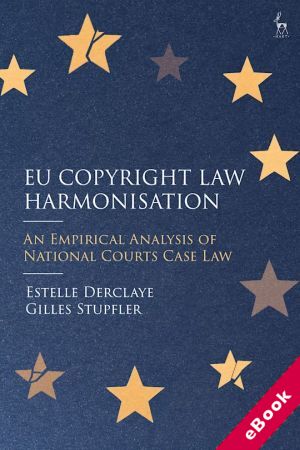
This book provides the first comprehensive comparative and empirical analysis of the state of harmonisation in EU copyright law in the 27 Member States, and the UK, at the level of national courts.
For 3 decades, the EU has harmonised many aspects of copyright law via EU legislation and the case law of the Court of Justice of the EU (CJEU). However, it is not known whether national courts actually comply with it, as a comprehensive analysis of the national case law has not yet been done. This book addresses this major gap in the literature.
In the book, a lawyer and a statistician analyse some of the most recent decisions on EU copyright law issued by the 27 Member States and the UK (pre- and post-Brexit), using doctrinal and quantitative methodologies. The main research question addressed is whether there is disharmony in the national case law and whether this is owed to Members States' misimplementing EU copyright legislation, lack of clarity of EU legislation and/or case law, or national courts misinterpreting or resisting CJEU case law.
The book provides detailed legal analyses and descriptive statistics per topic, per type of work, per country, across countries and over time supported by statistical analysis, where possible making inferences for the future development of the law. Its findings and in-depth reflections on the law and how to improve it are of crucial relevance for policymakers and the judiciary at EU and national level and will interest scholarly audiences in the UK, EU, EEA and beyond.










