The eBooks we sell are sold as a single-user licence and are intended for the end user only.
The sale of some eBooks are restricted to certain countries. To alert you to such restrictions, please select the country of the billing address of your credit or debit card you wish to use for payment.
For further information see https://www.wildy.com/ebook-formats
Once the order is confirmed an e-mail will be sent to you to allow you to download the eBook. For UK purchases this will be automatic. For purchases outside the UK a member of staff will need to confirm the sale. (Staff are available to do this during normal business hours, Mon-Fri 8:30-17:00 UK time)
All eBooks are supplied firm sale and cannot be returned. If you believe there is a fault with your eBook then contact us on ebooks@wildy.com and we will help in resolving the issue. This does not affect your statutory rights.
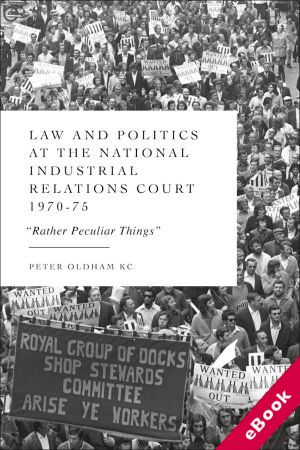
This book gives extraordinary new insights into the legal, political and industrial strife in the UK of the early 1970s, focusing on the National Industrial Relations Court and how its independence came to be injured at a time of national crisis.
Constitutional and employment lawyers, and indeed anyone interested in the history of the times, will not want to be without this deeply researched yet entertaining work.
When the Heath Government came to power in 1970, it set up the National Industrial Relations Court to referee highly contentious disputes between unions and employers. Regarded with hostility by the labour movement from the start, the Court and its President, Sir John Donaldson, faced mounting suspicion, and were regularly front-page news. When Donaldson jailed five dockers in 1972 – the Pentonville Five – for defying the Court's orders, strikes erupted and the docks closed. With the country's food supplies dwindling, a state of emergency loomed. How had it come to this? Could a way through be found?
This is a revelatory account of the National Industrial Relations Court's defining crisis, set in the context of a wider, and frequently startling, exposition of how Donaldson went about his role as its President.
Author Peter Oldham KC fuses decades of experience as a barrister with archival research to shine a bright new light on how and why the Court found itself doing – in Donaldson's own words – “rather peculiar things”.