The eBooks we sell are sold as a single-user licence and are intended for the end user only.
The sale of some eBooks are restricted to certain countries. To alert you to such restrictions, please select the country of the billing address of your credit or debit card you wish to use for payment.
For further information see https://www.wildy.com/ebook-formats
Once the order is confirmed an e-mail will be sent to you to allow you to download the eBook. For UK purchases this will be automatic. For purchases outside the UK a member of staff will need to confirm the sale. (Staff are available to do this during normal business hours, Mon-Fri 8:30-17:00 UK time)
All eBooks are supplied firm sale and cannot be returned. If you believe there is a fault with your eBook then contact us on ebooks@wildy.com and we will help in resolving the issue. This does not affect your statutory rights.
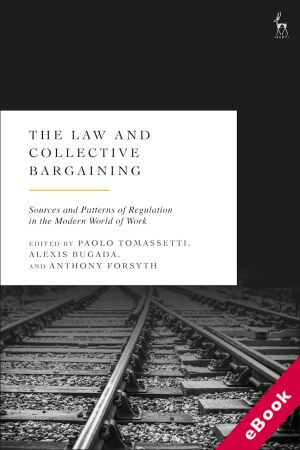
This book examines the relationship between the law and collective bargaining in the modern world of work.
It brings together theoretical, normative and practical perspectives from around the world to rethink the nexus between the two sources of work regulation in the face of unprecedented social and economic changes.
Recognised as a core international labour standard in many countries, collective bargaining is a fundamental institution of post-war democracies. Despite this, traditional collective bargaining systems inherited from the 20th-century industrial era are under pressure. Often linked to falling union density rates, collective agreement coverage has declined in some countries, while in others, high coverage conceals pitfalls such as rising inequality and labour disempowerment. This is the result of internal factors, such as the autonomous organisation and agency of industrial relations institutions, as well as external factors arising from globalisation, technological transformation, and 'fissured' business models which have distanced lead firms from workers, unions and collective action.
Drawing on a tradition of labour law scholarship grounded in legal pluralism, the book explores how legislators and industrial relations institutions are reshaping the law-collective bargaining nexus to cope with these challenges.
In addition to its utility as a resource for academics and students, the book provides practitioners, domestic legislators, judges and social partners with examples of best practice that will inform future reform processes.