
The eBooks we sell are sold as a single-user licence and are intended for the end user only.
The sale of some eBooks are restricted to certain countries. To alert you to such restrictions, please select the country of the billing address of your credit or debit card you wish to use for payment.
For further information see https://www.wildy.com/ebook-formats
Once the order is confirmed an e-mail will be sent to you to allow you to download the eBook. For UK purchases this will be automatic. For purchases outside the UK a member of staff will need to confirm the sale. (Staff are available to do this during normal business hours, Mon-Fri 8:30-17:00 UK time)
All eBooks are supplied firm sale and cannot be returned. If you believe there is a fault with your eBook then contact us on ebooks@wildy.com and we will help in resolving the issue. This does not affect your statutory rights.
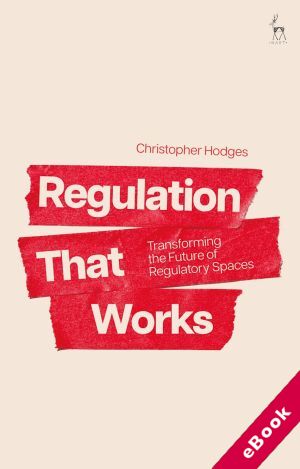
This book explains what regulation is – and is not.
It clarifies how regulation actually works, and how it can be made better. It also sets out how regulation should be done given fundamental challenges and changes to how we have done it. What is regulation trying to achieve? Is there too much red tape? Does regulation impede growth and innovation? Does regulation provide protection, and stability, and fair behaviours? Is it effective? How do we know if it succeeds?
The book illustrates competing regulatory models, and how multiple tools work – but also how things need to work differently in the future.
Given the pace of change in new technologies, creating unknown and uncontrollable risks, and the global nature of these technologies, we can only keep ourselves safe if we modernise how we 'do' regulation and work in collaborative ecosystems in which everyone works together to identify and control new harms. We should be aiming to achieve multiple outcomes, including protection as well as fair markets, facilitating innovation, and economic growth and social cohesion.
The book elucidates how this is all possible – if we organise ourselves and behave in new ways. Examples show sectors where all of this is already being applied - in Australia, Canada, New Zealand, and the UK.
This is a revolutionary book, and a must-read for anyone who wants to affect change in their regulatory spaces.










