
The eBooks we sell are sold as a single-user licence and are intended for the end user only.
The sale of some eBooks are restricted to certain countries. To alert you to such restrictions, please select the country of the billing address of your credit or debit card you wish to use for payment.
For further information see https://www.wildy.com/ebook-formats
Once the order is confirmed an e-mail will be sent to you to allow you to download the eBook. For UK purchases this will be automatic. For purchases outside the UK a member of staff will need to confirm the sale. (Staff are available to do this during normal business hours, Mon-Fri 8:30-17:00 UK time)
All eBooks are supplied firm sale and cannot be returned. If you believe there is a fault with your eBook then contact us on ebooks@wildy.com and we will help in resolving the issue. This does not affect your statutory rights.
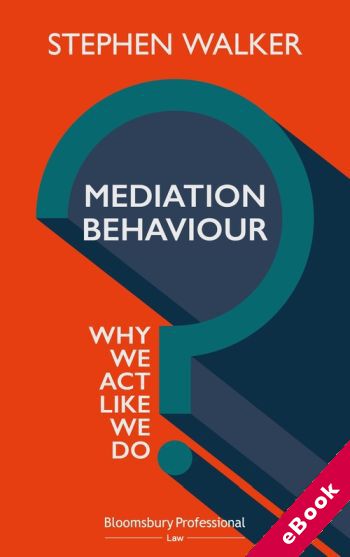
What is conflict? How does it arise? How can we prevent it?
Resolving conflict can end up costing the parties involved a considerable amount of money not only in relation to solicitors' and barristers' fees, court fees, expert witness' fees, etc, but also in time spent working on the resolution. There is also no guarantee that these costs will be fully recovered in any settlement agreement. It is, therefore, very important for parties in conflict to understand how to negotiate in order to reach the best outcome for all those involved they and the main part of this is understanding the psychology of conflict negotiation.
There is a lot of research available on this topic from behavioural economics and neuroscience to a lot of talk about cognitive biases and the dominance of emotion and whilst it is interesting, only some of it is relevant and, most importantly, is only useful if we understand how to use it when faced with conflict. How is it all used to benefit a conflict negotiation in practice?
Written from the point of the view of the disputing parties, their advisers and representatives and the mediators, Conflict Negotiation: The Psychology highlights only the relevant research, explains how to use it and illustrates how it works in practice through the use of detailed case studies, diagrams and visuals. It also looks at new techniques in negotiating conflict resolution.
Far from being an update and discussion of exisiting and exciting new research findings, Conflict Negotiation: The Psychology is experience based and arms those involved in conflict with the tools needed to negiotiate conflict successfully.










