
The eBooks we sell are sold as a single-user licence and are intended for the end user only.
The sale of some eBooks are restricted to certain countries. To alert you to such restrictions, please select the country of the billing address of your credit or debit card you wish to use for payment.
For further information see https://www.wildy.com/ebook-formats
Once the order is confirmed an e-mail will be sent to you to allow you to download the eBook. For UK purchases this will be automatic. For purchases outside the UK a member of staff will need to confirm the sale. (Staff are available to do this during normal business hours, Mon-Fri 8:30-17:00 UK time)
All eBooks are supplied firm sale and cannot be returned. If you believe there is a fault with your eBook then contact us on ebooks@wildy.com and we will help in resolving the issue. This does not affect your statutory rights.
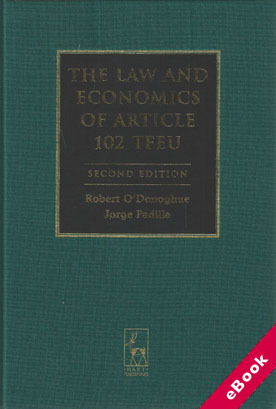
The Law and Economics of Article 102 TFEU is a comprehensive, integrated treatment of the legal and economic principles that underpin the application of Article 102 TFEU to the behaviour of dominant firms.
Traditional concerns of monopoly behaviour, such as predatory pricing, refusals to deal, excessive pricing, tying and bundling, discount practices and unlawful discrimination are treated in detail through a review of the applicable economic principles, the case law and decisional practice and more recent economic and legal writings.
In addition, the major constituent elements of Article 102 TFEU, such as market definition, dominance, effect on trade and applicable remedies are considered at length. Jointly authored by a lawyer and an economist, The Law and Economics of Abusive Dominance contains an integrated approach to the legal and economic principles that frame policy in this major area of competition law.
Although written primarily with practitioners and in-house lawyers in mind, it is essential reading for anyone with an interest in competition law enforcement against monopoly behaviour.










