
The eBooks we sell are sold as a single-user licence and are intended for the end user only.
The sale of some eBooks are restricted to certain countries. To alert you to such restrictions, please select the country of the billing address of your credit or debit card you wish to use for payment.
For further information see https://www.wildy.com/ebook-formats
Once the order is confirmed an e-mail will be sent to you to allow you to download the eBook. For UK purchases this will be automatic. For purchases outside the UK a member of staff will need to confirm the sale. (Staff are available to do this during normal business hours, Mon-Fri 8:30-17:00 UK time)
All eBooks are supplied firm sale and cannot be returned. If you believe there is a fault with your eBook then contact us on ebooks@wildy.com and we will help in resolving the issue. This does not affect your statutory rights.
Relocation cases are disputes between separated parents which arise when one parent proposes to move to a new geographic location with their child and the other parent objects to the proposal.
Relocation disputes are widely recognised as being amongst the most difficult cases facing family courts, and the law governing them is increasingly a cause for debate at both national and international levels.
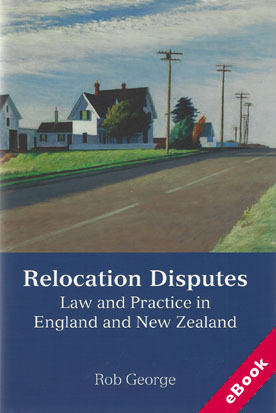
In Relocation Disputes: Law and Practice in England and New Zealand, Rob George looks at the different ways in which the legal systems of England and New Zealand currently deal with relocation cases. Drawing on case law, literature and the views of legal practitioners in the two jurisdictions,
Relocation Disputes represents a major contribution to our understanding of the everyday practice of relocation cases. The empirical data reported in this book reveal the practical differences between the English and New Zealand approaches to relocation, along with a detailed analysis of the pros and cons of each system as seen by judges, lawyers and court experts who deal with these cases in practice.
This analysis leads to detailed criticisms and lessons that can be learnt, together with practical suggestions about possible reforms of relocation law.











