
The eBooks we sell are sold as a single-user licence and are intended for the end user only.
The sale of some eBooks are restricted to certain countries. To alert you to such restrictions, please select the country of the billing address of your credit or debit card you wish to use for payment.
For further information see https://www.wildy.com/ebook-formats
Once the order is confirmed an e-mail will be sent to you to allow you to download the eBook. For UK purchases this will be automatic. For purchases outside the UK a member of staff will need to confirm the sale. (Staff are available to do this during normal business hours, Mon-Fri 8:30-17:00 UK time)
All eBooks are supplied firm sale and cannot be returned. If you believe there is a fault with your eBook then contact us on ebooks@wildy.com and we will help in resolving the issue. This does not affect your statutory rights.
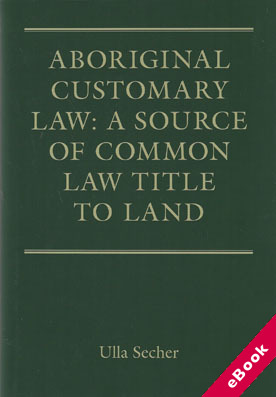
Described as "ground-breaking" in Kent McNeil's Foreword, this book develops an alternative approach to conventional Aboriginal title doctrine. It explains that Aboriginal customary law can be a source of common law title to land in former British colonies, whether they were acquired by settlement or by conquest or cession from another colonising power.
The doctrine of Common Law Aboriginal Customary Title provides a coherent approach to the source, content, proof and protection of Aboriginal land rights which overcomes problems arising from the law as currently understood and leads to more just results. The doctrine's applicability in Australia, Canada and South Africa is specifically demonstrated.
While the jurisprudential underpinnings for the doctrine are consistent with fundamental common law principles, the author explains that the Australian High Court's decision in Mabo provides a broader basis for the doctrine: a broader basis which is consistent with a re-evaluation of case-law from former British colonies in Africa, as well as from the United States, New Zealand and Canada.
In this context, the book proffers a reconceptualisation of the Crown's title to land in former colonies and a reassessment of conventional doctrines, including the doctrine of tenure and the doctrine of continuity.










