The eBooks we sell are sold as a single-user licence and are intended for the end user only.
The sale of some eBooks are restricted to certain countries. To alert you to such restrictions, please select the country of the billing address of your credit or debit card you wish to use for payment.
For further information see https://www.wildy.com/ebook-formats
Once the order is confirmed an e-mail will be sent to you to allow you to download the eBook. For UK purchases this will be automatic. For purchases outside the UK a member of staff will need to confirm the sale. (Staff are available to do this during normal business hours, Mon-Fri 8:30-17:00 UK time)
All eBooks are supplied firm sale and cannot be returned. If you believe there is a fault with your eBook then contact us on ebooks@wildy.com and we will help in resolving the issue. This does not affect your statutory rights.
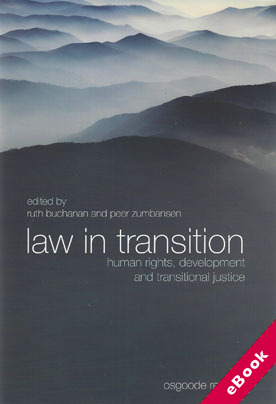
Law has become the vehicle by which countries in the 'developing world', including post-conflict states or states undergoing constitutional transformation, must steer the course of social and economic, legal and political change.
Legal mechanisms, in particular, the instruments as well as concepts of human rights, play an increasingly central role in the discourses and practices of both development and transitional justice. These developments can be seen as part of a tendency towards convergence within the wider set of discourses and practices in global governance.
While this process of convergence of formerly distinct normative and conceptual fields of theory and practice has been both celebrated and critiqued at the level of theory, the present collection provides, through a series of studies drawn from a variety of contexts in which human rights advocacy and transitional justice initiatives are colliding with development projects, programmes and objectives, a more nuanced and critical account of contemporary developments.
The book includes essays by many of the leading experts writing at the intersection of development, rights and transitional justice studies. Notwithstanding the theoretical and practical challenges presented by the complex interaction of these fields, the premise of the book is that it is only through engagement and dialogue among hitherto distinct fields of scholarship and practice that a better understanding of the institutional and normative issues arising in contemporary law and development and transitional justice contexts will be possible.
The book is designed for research and teaching at both undergraduate and graduate levels.