
The eBooks we sell are sold as a single-user licence and are intended for the end user only.
The sale of some eBooks are restricted to certain countries. To alert you to such restrictions, please select the country of the billing address of your credit or debit card you wish to use for payment.
For further information see https://www.wildy.com/ebook-formats
Once the order is confirmed an e-mail will be sent to you to allow you to download the eBook. For UK purchases this will be automatic. For purchases outside the UK a member of staff will need to confirm the sale. (Staff are available to do this during normal business hours, Mon-Fri 8:30-17:00 UK time)
All eBooks are supplied firm sale and cannot be returned. If you believe there is a fault with your eBook then contact us on ebooks@wildy.com and we will help in resolving the issue. This does not affect your statutory rights.
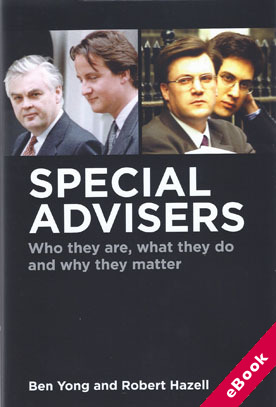
Viewers of The Thick of It will know of special advisers as spin doctors and political careerists. Several well-known ministers have been special advisers, among them David Cameron, Ed Miliband, Jack Straw and Vince Cable.
People also know about the public relations disasters involving Jo Moore, Damian McBride and Adam Smith. But what is the reality? What do special advisers actually do in government? Who are they, where do they come from, and what do they go on to do?
This book is the most detailed study yet carried out of special advisers. The Constitution Unit's research team, led by Dr Ben Yong and Professor Robert Hazell, assembled a comprehensive database of over 600 special advisers since 1979. They conducted written surveys, and interviewed over 100 special advisers, ministers and officials from the past thirty years. They conclude that special advisers are now a permanent and indispensable part of Whitehall, but are still treated as transient and temporary.
The book concludes with practical recommendations for increasing the effectiveness of special advisers through improvements to their recruitment, induction and training, support and supervision, and strengthening their accountability.











