
The eBooks we sell are sold as a single-user licence and are intended for the end user only.
The sale of some eBooks are restricted to certain countries. To alert you to such restrictions, please select the country of the billing address of your credit or debit card you wish to use for payment.
For further information see https://www.wildy.com/ebook-formats
Once the order is confirmed an e-mail will be sent to you to allow you to download the eBook. For UK purchases this will be automatic. For purchases outside the UK a member of staff will need to confirm the sale. (Staff are available to do this during normal business hours, Mon-Fri 8:30-17:00 UK time)
All eBooks are supplied firm sale and cannot be returned. If you believe there is a fault with your eBook then contact us on ebooks@wildy.com and we will help in resolving the issue. This does not affect your statutory rights.
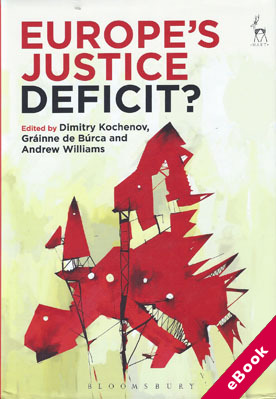
The gradual legal and political evolution of the European Union has not, thus far, been accompanied by the articulation or embrace of any substantive ideal of justice going beyond the founders' intent or the economic objectives of the market integration project.
This absence arguably compromises the foundations of the EU legal and political system since the relationship between law and justice - a crucial question within any constitutional system - remains largely unaddressed.
This edited volume brings together a number of concise contributions by leading academics and young scholars whose work addresses both legal and philosophical aspects of justice in the European context. The aim of the volume is to appraise the existence and nature of this deficit, its implications for Europe's future, and to begin a critical discussion about how it might be addressed.
There have been many accounts of the EU as a story of constitutional evolution and a system of transnational governance, but few which pay sustained attention to the implications for justice. The EU today has moved beyond its initial and primary emphasis on the establishment of an internal market, as the growing importance of EU citizenship and social rights suggests.
Yet, most legal analyses of the EU Treaties and of EU case law remain premised broadly on the assumption that EU law still largely serves the purpose of perfecting what is fundamentally a system of economic integration. The place to be occupied by the underlying substantive ideal of justice remains significantly underspecified or even vacant, creating a tension between the market-oriented foundation of the Union and the contemporary essence of its constitutional system.
The relationship of law to justice is a core dimension of constitutional systems around the world, and the EU is arguably no different in this respect. The critical assessment of justice in the EU provided by the contributions to this book will help to create a fuller picture of the justice deficit in the EU, and at the same time open up an important new avenue of legal research of immediate importance.










