
The eBooks we sell are sold as a single-user licence and are intended for the end user only.
The sale of some eBooks are restricted to certain countries. To alert you to such restrictions, please select the country of the billing address of your credit or debit card you wish to use for payment.
For further information see https://www.wildy.com/ebook-formats
Once the order is confirmed an e-mail will be sent to you to allow you to download the eBook. For UK purchases this will be automatic. For purchases outside the UK a member of staff will need to confirm the sale. (Staff are available to do this during normal business hours, Mon-Fri 8:30-17:00 UK time)
All eBooks are supplied firm sale and cannot be returned. If you believe there is a fault with your eBook then contact us on ebooks@wildy.com and we will help in resolving the issue. This does not affect your statutory rights.
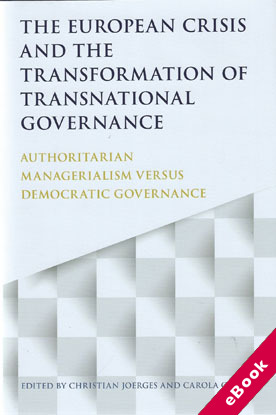
The debate on law, governance and constitutionalism beyond the state is confronted with new challenges. In the EU, confidence in democratic transnational governance has been shaken by the authoritarian and unsocial practices of crisis management.
The ambition of this book, which builds upon many years of close co-operation between its contributors, is to promote a viable interdisciplinary alternative to these developments. "Conflicts-law constitutionalism" is a concept of transnational governance which derives democratic legitimacy from the supranational control of the external impact of national decision-making, on the one hand, and the co-operative responses to problem interdependencies on the other.
The first section of the book contrasts Europe's new modes of economic governance crisis management with the conditionality of international investments, and reflects upon the communalities and differences between emergency Europe and global exceptionalism.
Subsequent sections substantiate the problematique of executive and technocratic rule, explore conflict constellations of prime importance in the fields of environmental and labour law, and discuss the impact and limits of liberalisation strategies. Throughout the book, European and transnational developments are compared and evaluated.











