
The eBooks we sell are sold as a single-user licence and are intended for the end user only.
The sale of some eBooks are restricted to certain countries. To alert you to such restrictions, please select the country of the billing address of your credit or debit card you wish to use for payment.
For further information see https://www.wildy.com/ebook-formats
Once the order is confirmed an e-mail will be sent to you to allow you to download the eBook. For UK purchases this will be automatic. For purchases outside the UK a member of staff will need to confirm the sale. (Staff are available to do this during normal business hours, Mon-Fri 8:30-17:00 UK time)
All eBooks are supplied firm sale and cannot be returned. If you believe there is a fault with your eBook then contact us on ebooks@wildy.com and we will help in resolving the issue. This does not affect your statutory rights.
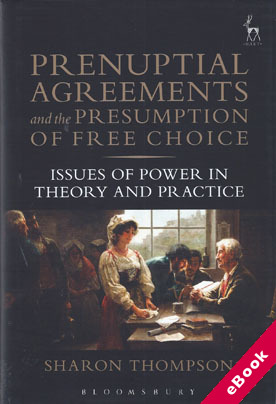
This book provides an alternative perspective on an issue fraught with difficulty - the enforcement of prenuptial agreements. Such agreements are enforced because the law acknowledges the rights of spouses and civil partners to make autonomous decisions about the division of their property on divorce. Yet the book will demonstrate that, in the attempt to promote autonomy, other issues such as imbalance of power between the parties become obscured.
The book offers an academic and practical analysis of the real impact of prenuptial agreements on the relationships of those involved. Using a feminist and contractual theoretical framework, this book attempts to produce a more nuanced understanding of the autonomy exercised by parties entering into prenuptial agreements. The book also draws on an empirical study of the experiences and views of practitioners skilled in the formation and litigation of prenuptial agreements in New York.
Finally, the book explores how the court might address concerns with power and autonomy during the drafting and enforcement processes of prenuptial agreements, which in turn may enhance the role that prenups can play in the judicial allocation of spousal property on the breakdown of marriage.










