
The eBooks we sell are sold as a single-user licence and are intended for the end user only.
The sale of some eBooks are restricted to certain countries. To alert you to such restrictions, please select the country of the billing address of your credit or debit card you wish to use for payment.
For further information see https://www.wildy.com/ebook-formats
Once the order is confirmed an e-mail will be sent to you to allow you to download the eBook. For UK purchases this will be automatic. For purchases outside the UK a member of staff will need to confirm the sale. (Staff are available to do this during normal business hours, Mon-Fri 8:30-17:00 UK time)
All eBooks are supplied firm sale and cannot be returned. If you believe there is a fault with your eBook then contact us on ebooks@wildy.com and we will help in resolving the issue. This does not affect your statutory rights.
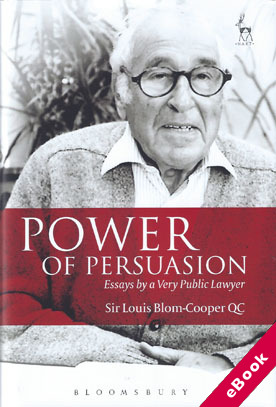
Over the developing years of the judicial review of ministerial and governmental decisions, Louis Blom-Cooper was a leading advocate who grew up with the advent of a distinctive brand of public law. His range of public activities, both in and outwith the courtroom, saw him dubbed by his colleagues as a polymath practitioner.
It included chairmanship of plural public inquiries in child abuse and mental health, media contributions in the broadsheet press and in broadcasting, and innovation in penal reform, as an ardent campaigner for the abolition of capital punishment and a plea for a modern Homicide Act. He styled himself as a modern, reconstructed liberal - a man before his time.
This collection of essays is uniquely prefaced by a self-examination of his unorthodox philosophy towards the law in action. It covers a variety of socio-legal topics that expresses his ambition to inform a poorly-educated public on the workings of the legal system. This aim involves a discussion of the constitutional history of Britain, unwritten and insufficiently interpreted; it reflects a commitment to the European Convention on Human Rights and portrays its international origins.
The collection opines on crime and punishment; in the functioning of the courts and elsewhere the political shift from the penal optimism of the 1970s to the reactionary punitiveness of the post-1990s. The essays conclude with a miscellany of affairs, reflecting on professional practices and their product of judicial heroes in Lord Reid and Lord Bingham.











