
The eBooks we sell are sold as a single-user licence and are intended for the end user only.
The sale of some eBooks are restricted to certain countries. To alert you to such restrictions, please select the country of the billing address of your credit or debit card you wish to use for payment.
For further information see https://www.wildy.com/ebook-formats
Once the order is confirmed an e-mail will be sent to you to allow you to download the eBook. For UK purchases this will be automatic. For purchases outside the UK a member of staff will need to confirm the sale. (Staff are available to do this during normal business hours, Mon-Fri 8:30-17:00 UK time)
All eBooks are supplied firm sale and cannot be returned. If you believe there is a fault with your eBook then contact us on ebooks@wildy.com and we will help in resolving the issue. This does not affect your statutory rights.
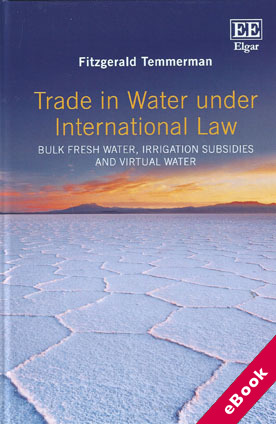
Freshwater is an increasingly scarce resource globally, and effective sustainable management will be absolutely crucial in the future.
This timely book sets out future scenarios of international trade in both 'real' and 'virtual' water, examining the relationship between climate change, water scarcity, the human right to water and WTO law.
Trade in Water under International Law addresses questions of global importance such as: how can international trade in bulk water contribute to the advancement of the human right to water? Are 'green-boxed' irrigation subsidies disturbing the markets? Should water-footprint process and production methods allow for a different treatment of otherwise 'like' products?
From examining the impact of water law on small-scale farmers in developing countries, to the broader issue of global environmental responsibility, Fitzgerald Temmerman explores the options available for fair resource allocation through international law arrangements such as the General Agreement on Tariffs and Trade and the Agreement on Technical Barriers to Trade.
By taking a wide-reaching and non-technical approach, this book will capture the attention not only of international trade law professionals, but of all stakeholders in the field. With such relevance to contemporary environmental issues, this book will also interest non-legally qualified individuals who want to comprehend the future possibilities of fair water trade.










