
The eBooks we sell are sold as a single-user licence and are intended for the end user only.
The sale of some eBooks are restricted to certain countries. To alert you to such restrictions, please select the country of the billing address of your credit or debit card you wish to use for payment.
For further information see https://www.wildy.com/ebook-formats
Once the order is confirmed an e-mail will be sent to you to allow you to download the eBook. For UK purchases this will be automatic. For purchases outside the UK a member of staff will need to confirm the sale. (Staff are available to do this during normal business hours, Mon-Fri 8:30-17:00 UK time)
All eBooks are supplied firm sale and cannot be returned. If you believe there is a fault with your eBook then contact us on ebooks@wildy.com and we will help in resolving the issue. This does not affect your statutory rights.
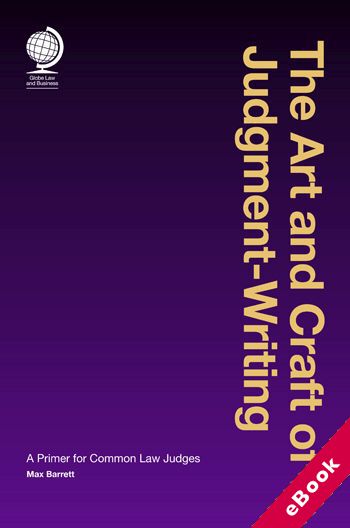
Judges are increasingly aware that the best way of enhancing public confidence in court systems is not only by providing a quality service but doing so compassionately and respectfully. The art and craft of judgment-writing is a critical element of this process. This book looks at the judgments of historically great judgment-writers from the US, UK and wider common law world (in particular Australia, Canada, India, Ireland, Israel and New Zealand). It is written not from the perspective of what the author can teach but with the aim of identifying essential elements of good judgment-writing in great judgments and insightful commentary.
Written by Dr Max Barrett, a judge of the High Court of Ireland, individual chapters focus on subjects such as judgment purpose, length, style and structure, concurring and dissenting judgments, judgment-writing for children and vulnerable parties, as well as more general lessons in good writing offered by great authors from Orwell to Twain. Among the lessons to be taken from great common law judges are that:
A great author such as Mark Twain teaches, for example, that:
This book is intended for novice superior court judges, their more seasoned colleagues and all with an interest in legal writing (including legal practitioners, law teachers and law students). Lower-court judges required to write judgments should find the book valuable; and judges at all levels should find the additional chapter on ex tempore judgments of use.











