
The eBooks we sell are sold as a single-user licence and are intended for the end user only.
The sale of some eBooks are restricted to certain countries. To alert you to such restrictions, please select the country of the billing address of your credit or debit card you wish to use for payment.
For further information see https://www.wildy.com/ebook-formats
Once the order is confirmed an e-mail will be sent to you to allow you to download the eBook. For UK purchases this will be automatic. For purchases outside the UK a member of staff will need to confirm the sale. (Staff are available to do this during normal business hours, Mon-Fri 8:30-17:00 UK time)
All eBooks are supplied firm sale and cannot be returned. If you believe there is a fault with your eBook then contact us on ebooks@wildy.com and we will help in resolving the issue. This does not affect your statutory rights.
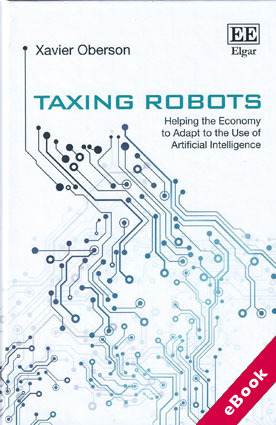
The increasing use of artificial intelligence within the workplace is likely to cause significant disruption to the labour market and in turn, to the economy, due to a reduction in the number of taxable workers. In this innovative book, Xavier Oberson proposes taxing robots as a possible solution to the anticipated problem of declining tax revenues.
In accordance with guiding legal and economic principles, the book explores the various tax models that could be applied to both the use of robots, such as a usage or automation tax, and to robots directly. Numerous associated issues are discussed, such as the definition of robots for tax purposes, the difficulty of granting a tax capacity to robots, as well as the compatibility of robot taxes with international tax rules. The author concludes by putting forward a possible system for the taxation of robots, taking all of these issues into consideration.
Being the first work of its kind to explore the potential for taxing robots in detail, this book will be a unique resource for researchers in the fields of law and economics who have an interest in the impact of artificial intelligence. Lawyers and tax professionals can also benefit from Oberson’s insights on what future models of taxation may look like and what the legal consequences may be.










