
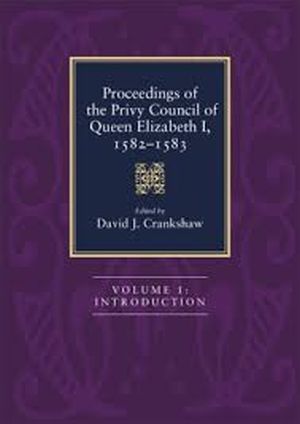
Important edition of central government records for Elizabeth I makes vital information available to historians.
By 1540, the Privy Council had become the Crown’s principal policy-making and executive arm. Under the later Tudors, it governed England on the sovereign’s behalf: conduit and buffer between the itinerant Court and the provinces. A small, elite board imbued with a sense of collective responsibility, the Council sought to implement policy chiefly by issuing orders as letters or warrants. However, the institution’s Elizabethan registers – disclosing meeting attendance and summarizing out-going correspondence – are lost for 37% of the reign, while extant registers are incomplete: over-worked clerks omitted many dispatches, even crucial ones, which only survive as either originals or copies, widely dispersed. The longest gap in Kew’s register series is June 1582-February 1585/86: a large slice of, arguably, the pivotal decade of Gloriana’s incumbency. Although the Elizabethan registers known to the Victorians were published 1893-1907, they appeared inaccurately, lacking significant editorial apparatus.
This four-volume set covers the beginning of that gap and avoids those deficiencies. Part I presents a newly discovered original Privy Council register, comprising 672 entries, presumed destroyed in the January 1618/19 Whitehall Palace fire. Of the actual dispatches for June 1582-June 1583, 103 texts are recoverable, assembled in Part II and cross-referenced to the appropriate register notices, if they exist, so that historians may consult entire documents, rather than rely upon the clerks’ often crude abstracts. Ancillary material is printed in nine appendices; the greatest reconstructs each English shire’s magistracy. All sources published here are fully contextualized using the latest scholarship.
Parts I and II reveal activity in myriad spheres: political, religious, social, legal and economic; rarer items address foreign affairs. Yet Proceedings of the Privy Council of Queen Elizabeth I, 1582-1583 does more than merely offer rich new sources. The two-volume Introduction firstly describes the register and relates it to conciliar working and archival practices. Next comes contextualization of the Council ideologically and constitutionally. The most comprehensive and original for a generation, this analysis blends legal history and the history of political thought to give an account of the mixed polity, of the tyrannical potential of the royal prerogative and of the mechanism by which the sovereign-state nexus was transformed into a framework of counsel, consent and justice under the monarch’s absolute and ordinary prerogatives. The editor then traces the Privy Council’s evolution from the medieval King’s Council before assessing the ‘monarchical republic’ thesis in the light of the board’s interactions with the queen in 1582-83. Concluding thematic essays show how details in Parts I and II contribute to major revisions of received interpretations. Themes include ‘Plague’ and ‘Landscape and infrastructure’. The long final essay divides: the bulk elucidates England’s religious politics of 1572-83, integrating Scottish and continental developments and paying close attention to the growing ‘popish’ threat, pre-eminently the Jesuit mission of 1580-81; a coda examines the Council’s fund-raising campaign to relieve Calvinist Geneva. This important edition of central governmental records will thus be of special interest to everyone concerned with the history of the Elizabethan State and with the doings of its conciliar statesmen.










