
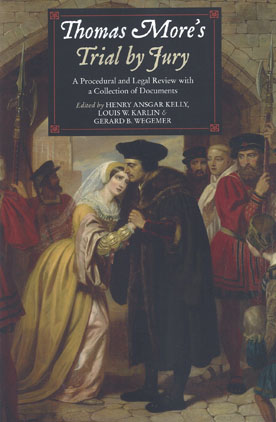
This book challenges the recently established consensus that the trial was a carefully prepared and executed judicial process in which the judges were amenable to reasonable arguments. Thomas More's treason trial in 1535 is one of history's most famous court cases, yet never before have all the major documents been collected, translated, and analyzed by a team of legal and Tudor scholars. This edition serves asan important sourcebook and concludes with a 'docudrama' reconstructing the course of the trial based on these documents.
Legal experts H. A. Kelly and R. H. Helmholz take different approaches to the legalities of this trial, and four experienced judges [including Justice of the Queen's Bench Sir Michael Tugendhat] discuss the trial with some disagreements - notably on the meaning and requirement of 'malice' called for in the Parliamentary Act of Supremacy. More's own accounts of his interrogations in prison are analyzed, and the trial's procedures are compared to and contrasted with 16th-century concepts of natural law and also modern judicial practices and principles.
The book is a 'must read' not only for students of law and Tudor history but also for all concerned with justice and due process. As a whole, the book challenges Duncan Derrett's conclusions that the trial was conducted in accord with contemporary legal norms and that More was convicted only on the single charge of denying Parliament the power to declare Henry VIII Supreme Head of the English Church [testified to by Richard Rich] - a position that has been uniformly accepted by historians since 1964.











