
The eBooks we sell are sold as a single-user licence and are intended for the end user only.
The sale of some eBooks are restricted to certain countries. To alert you to such restrictions, please select the country of the billing address of your credit or debit card you wish to use for payment.
For further information see https://www.wildy.com/ebook-formats
Once the order is confirmed an e-mail will be sent to you to allow you to download the eBook. For UK purchases this will be automatic. For purchases outside the UK a member of staff will need to confirm the sale. (Staff are available to do this during normal business hours, Mon-Fri 8:30-17:00 UK time)
All eBooks are supplied firm sale and cannot be returned. If you believe there is a fault with your eBook then contact us on ebooks@wildy.com and we will help in resolving the issue. This does not affect your statutory rights.
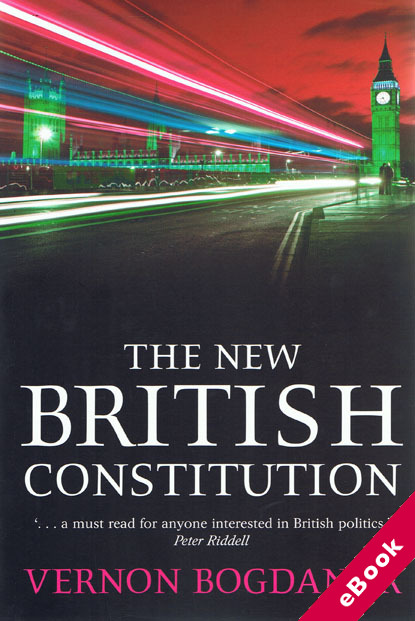
The British constitution, for so long considered entrenched by tradition and history has, since 1997, undergone a process unique in the democratic world - piecemeal transformation from uncodified to codified status. This process, spear-headed by the Human Rights Act and devolution to the non-English parts of the United Kingdom (at present there exists neither the political will nor the consensus to go further) has created a new constitution, characterised by limitation of the powers of Parliament.
The Human Rights Act and the devolution legislation, having the character of fundamental law, in practice limit the rights of Westminster as a sovereign parliament, and establish a constitution which is quasi-federal in nature. And though these reforms, together with Britain's membership of the European Union, do little to secure more popular involvement in politics, they nevertheless serve to replace one constitution by another.
The next phase of constitutional reform is likely to involve the creation of new forms of democratic engagement, so that Britain's constitutional forms come to be more congruent with the social and political forces of the age. The end-point of this piecemeal process might well be a fully codified or written constitution which declares that power stems not from the Queen-in-Parliament, but, instead, as so many constitutions do, from 'We the People'.
This new book, by one of Britain's most respected and experienced constitutional commentators, charts the emergence and significance of these reforms, and evaluates their success as part of a larger historical shift towards the constitutionalising of British democracy. While opinion is sharply divided as to the way forward, the author argues that former Prime Minister Tony Blair's most permanent legacy may well prove to be his championing of a new British constitution. Those seeking an authoritative insight into the state of that constitution need look no further.










