
The eBooks we sell are sold as a single-user licence and are intended for the end user only.
The sale of some eBooks are restricted to certain countries. To alert you to such restrictions, please select the country of the billing address of your credit or debit card you wish to use for payment.
For further information see https://www.wildy.com/ebook-formats
Once the order is confirmed an e-mail will be sent to you to allow you to download the eBook. For UK purchases this will be automatic. For purchases outside the UK a member of staff will need to confirm the sale. (Staff are available to do this during normal business hours, Mon-Fri 8:30-17:00 UK time)
All eBooks are supplied firm sale and cannot be returned. If you believe there is a fault with your eBook then contact us on ebooks@wildy.com and we will help in resolving the issue. This does not affect your statutory rights.
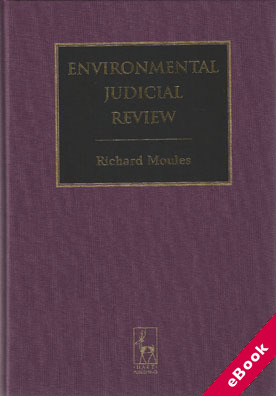
Judicial review of environmental decisions is an important and growing area of public law. But although the general principles of judicial review have been clearly mapped out, their application to the particular context of the environment is under-explored.
This book therefore seeks to provide a detailed and critical account of environmental judicial review in both domestic and EU law. Part 1 explains the central principles of environmental law, such as the polluter pays principle and the precautionary principle, and shows how they influence the application of public law standards of legality.
Part 2 considers the procedure for judicial review with particular emphasis on standing, protective costs, and the availability of interim relief. Part 3 consists of a detailed examination of how each of the grounds for judicial review are applied in the environmental context. It highlights the increased emphasis on consultation and public participation in environmental matters, the degree of deference afforded by the courts to scientific and political judgments, and the prevalence of 'hard-edged' questions of law.
Part 4 focuses on EU law and examines direct and indirect actions before the EU courts, preliminary references, and state liability. Part 5 explains the complex regime governing access to environmental information.
Finally, Part 6 considers infraction proceedings brought by the EU Commission, the role of individuals and NGOs in relation to such proceedings and the interrelationships between infraction proceedings and judicial review.










