
The eBooks we sell are sold as a single-user licence and are intended for the end user only.
The sale of some eBooks are restricted to certain countries. To alert you to such restrictions, please select the country of the billing address of your credit or debit card you wish to use for payment.
For further information see https://www.wildy.com/ebook-formats
Once the order is confirmed an e-mail will be sent to you to allow you to download the eBook. For UK purchases this will be automatic. For purchases outside the UK a member of staff will need to confirm the sale. (Staff are available to do this during normal business hours, Mon-Fri 8:30-17:00 UK time)
All eBooks are supplied firm sale and cannot be returned. If you believe there is a fault with your eBook then contact us on ebooks@wildy.com and we will help in resolving the issue. This does not affect your statutory rights.
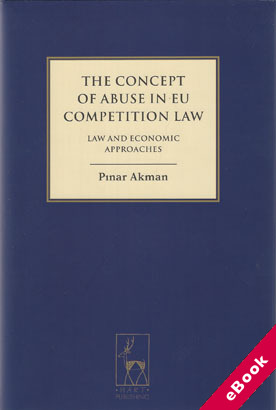
The objective(s) of Article 102 TFEU, the EU provision prohibiting the abuse of a dominant position, have not been settled to date. Using law and economic approaches, this book inquires into the possible objectives of Article 102TFEU and proposes a modern approach to interpreting 'abuse'.
This aim is achieved by placing the main focus of the analysis on 'exploitative abuse'. Although it is indisputable that Article 102TFEU prohibits 'exploitation', there is neither a comprehensive study of 'exploitative abuse' in the literature nor any guidance in the Commission's policy documents.
However, a reform of the approach to Article 102TFEU cannot be complete without answering the question of how to deal with exploitative abuses, such as excessive pricing, discrimination, etc.
The working hypothesis of the book is that the separation of exploitative abuse from exclusionary abuse is artificial and unsound. Hence, this book aims to further the current understanding of 'abuse' and to establish an economically-sound test of infringement which can inform policy and law in this area.
Starting with an examination of the roots of Article 102TFEU and of the historical context of the adoption of the Treaty, this book analyses the case law, policy and literature on exploitative abuses and, where relevant, exclusionary abuses.
The book investigates potential welfarist and non-welfarist objectives, such as fairness and (consumer) welfare, as well as the potential conflict between such objectives. Finally, the book critically assesses the Commission's modernisation of Article 102TFEU and proposes a reformed approach to 'abuse' which fuses 'exploitative' with 'exclusionary' abuse.










