
The eBooks we sell are sold as a single-user licence and are intended for the end user only.
The sale of some eBooks are restricted to certain countries. To alert you to such restrictions, please select the country of the billing address of your credit or debit card you wish to use for payment.
For further information see https://www.wildy.com/ebook-formats
Once the order is confirmed an e-mail will be sent to you to allow you to download the eBook. For UK purchases this will be automatic. For purchases outside the UK a member of staff will need to confirm the sale. (Staff are available to do this during normal business hours, Mon-Fri 8:30-17:00 UK time)
All eBooks are supplied firm sale and cannot be returned. If you believe there is a fault with your eBook then contact us on ebooks@wildy.com and we will help in resolving the issue. This does not affect your statutory rights.
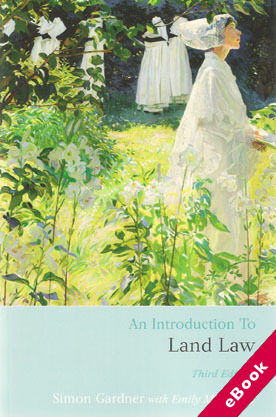
The rules of land law are numerous, complex, and in some cases baffling to students. The study of land law is also often portrayed as dull. Too frequently those who find success in working out how the law operates in other areas find themselves defeated by land law.
Even the great jurist Blackstone, while maintaining that 'there is nothing which so generally strikes the imagination, and engages the affections of mankind, as the right of property', also concluded that the study of land law 'afforded the student less amusement and pleasure in the pursuit' than the study of crime and tort.
This book tries to help with that problem. It aims to tell the rules' story: to talk about them in terms of the work they do, in a way that will allow readers to understand and engage with them. And through the examples it offers, it aims also to give students the confidence, spur and tools to go on to develop such perspectives for themselves.
The book covers the main points of land law found in the syllabuses of law schools in England and Wales. While it is not intended as a comprehensive textbook on the topic, it offers sufficient detail for anyone reading it to gain an overview of the subject, and for those seeking more the footnotes offer plenty of pointers.
As well as bringing the coverage up to date, this new edition adds chapters about two especially challenging aspects of the subject: the human rights dimension, and the nature of 'ownership'.










