
The eBooks we sell are sold as a single-user licence and are intended for the end user only.
The sale of some eBooks are restricted to certain countries. To alert you to such restrictions, please select the country of the billing address of your credit or debit card you wish to use for payment.
For further information see https://www.wildy.com/ebook-formats
Once the order is confirmed an e-mail will be sent to you to allow you to download the eBook. For UK purchases this will be automatic. For purchases outside the UK a member of staff will need to confirm the sale. (Staff are available to do this during normal business hours, Mon-Fri 8:30-17:00 UK time)
All eBooks are supplied firm sale and cannot be returned. If you believe there is a fault with your eBook then contact us on ebooks@wildy.com and we will help in resolving the issue. This does not affect your statutory rights.
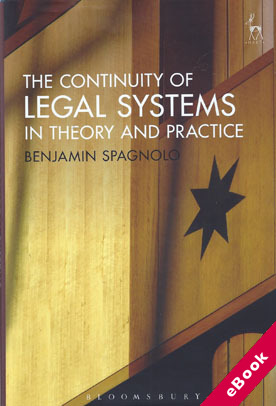
The Continuity of Legal Systems in Theory and Practice examines a persistent and fascinating question about the continuity of legal systems: when is a legal system existing at one time the same legal system that exists at another time?
The book's distinctive approach to this question is to combine abstract critical analysis of two of the most developed theories of legal systems, those of Hans Kelsen and Joseph Raz, with an evaluation of their capacity, in practice, to explain the facts, attitudes and normative standards for which they purport to account.
That evaluation is undertaken by reference to Australian constitutional law and history, whose diverse and complex phenomena make it particularly apt for evaluating the theories’ explanatory power.
In testing whether the depiction of Australian law presented by each theory achieves an adequate ‘fit’ with historical facts, the book also contributes to the understanding of Australian law and legal systems between 1788 and 2001. By collating the relevant Australian materials systematically for the first time, it presents the case for reconceptualising the role of Imperial laws and institutions during the late nineteenth and early twentieth centuries, and clarifies the interrelationship between Colonial, State, Commonwealth and Imperial legal systems both before and after Federation.











