
The eBooks we sell are sold as a single-user licence and are intended for the end user only.
The sale of some eBooks are restricted to certain countries. To alert you to such restrictions, please select the country of the billing address of your credit or debit card you wish to use for payment.
For further information see https://www.wildy.com/ebook-formats
Once the order is confirmed an e-mail will be sent to you to allow you to download the eBook. For UK purchases this will be automatic. For purchases outside the UK a member of staff will need to confirm the sale. (Staff are available to do this during normal business hours, Mon-Fri 8:30-17:00 UK time)
All eBooks are supplied firm sale and cannot be returned. If you believe there is a fault with your eBook then contact us on ebooks@wildy.com and we will help in resolving the issue. This does not affect your statutory rights.
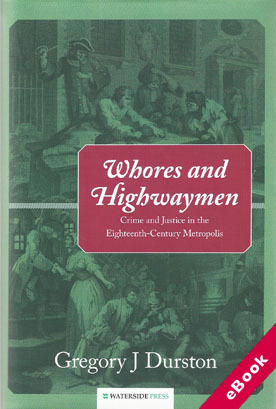
Running to 700 pages, this comprehensive work on the development of summary jurisdiction, early policing and the emergence of London’s embryonic modern criminal justice system looks at every aspect of these topics from numerous perspectives and across the eighteenth century.
The whores’ and highwaymen of Gregory Durston’s title are just some of the dubious characters met within this absorbing work, including thief-takers, trading justices, an upstart legal profession whose lower orders developed various ways to line their own pockets and magistrates and clerks who often preferred dealing with those cases which attracted fees.
The book shows how little was planned by government or the authorities, and how much sprang up due to the efforts of individuals — so that the origins of social control, particularly at a local level, had much to do with personal ideas of morality, class boundaries and perceived threats, serious and otherwise.
Based on news reports, Old Bailey and local archives, and other solid records the book weaves a compelling picture of a critical time in English history, through the voices of contemporary observers as well as the best of writings by experts ever since. At its broadest point, the book spans the period from the Glorious Revolution to the early 1820s. It falls into three parts:-
It concentrates on the Metropolis but also compares other parts of England and Wales.










