
The eBooks we sell are sold as a single-user licence and are intended for the end user only.
The sale of some eBooks are restricted to certain countries. To alert you to such restrictions, please select the country of the billing address of your credit or debit card you wish to use for payment.
For further information see https://www.wildy.com/ebook-formats
Once the order is confirmed an e-mail will be sent to you to allow you to download the eBook. For UK purchases this will be automatic. For purchases outside the UK a member of staff will need to confirm the sale. (Staff are available to do this during normal business hours, Mon-Fri 8:30-17:00 UK time)
All eBooks are supplied firm sale and cannot be returned. If you believe there is a fault with your eBook then contact us on ebooks@wildy.com and we will help in resolving the issue. This does not affect your statutory rights.
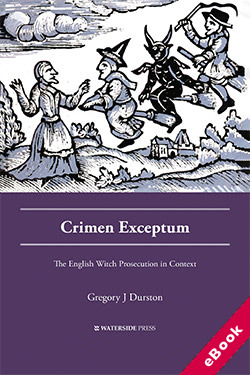
As the author notes, ‘The early-modern European witch-hunts were neither orchestrated massacres nor spontaneous pogroms. Alleged witches were not rounded up at night and summarily killed extra-judicially or lynched as the victims of mob justice. They were executed after trial and conviction with full legal process’.
In this concise but highly-informed account of the persecution of witches Gregory Durston demonstrates what a largely ordered process was the singling-out or hunting-down of perceived offenders. How a mix of superstition, fear, belief and ready explanations for ailments, misfortune or disasters caused law, politics and religion to indulge in criminalisation and the appearance of justice.
Bearing echoes of modern-day ‘othering’ and marginalisation of outsiders he shows how witchcraft became akin to treason (with its special rules), how evidentially speaking storms, sickness or coincidence might be attributed to conjuring, magic, curses and spells. All this reinforced by examples and detailed references to the law and practice through which a desired outcome was achieved.
In another resonance with modern times, the author shows how decisions were often diverted into the hands of witch-hunters, witch-finders (including self-appointed Witchfinder General, Matthew Hopkins), witch-prickers and other experts as well as the quaintly titled ‘cunning-folk’ consulted by prosecutors and ‘victims’.
Crimen Exceptum (crimes apart). A straightforward and authoritative guide. Shows the rise and fall of prosecutions. Backed by a wealth of learning and research.











