
The eBooks we sell are sold as a single-user licence and are intended for the end user only.
The sale of some eBooks are restricted to certain countries. To alert you to such restrictions, please select the country of the billing address of your credit or debit card you wish to use for payment.
For further information see https://www.wildy.com/ebook-formats
Once the order is confirmed an e-mail will be sent to you to allow you to download the eBook. For UK purchases this will be automatic. For purchases outside the UK a member of staff will need to confirm the sale. (Staff are available to do this during normal business hours, Mon-Fri 8:30-17:00 UK time)
All eBooks are supplied firm sale and cannot be returned. If you believe there is a fault with your eBook then contact us on ebooks@wildy.com and we will help in resolving the issue. This does not affect your statutory rights.
Due to a technical issue some ebooks are not available to order.
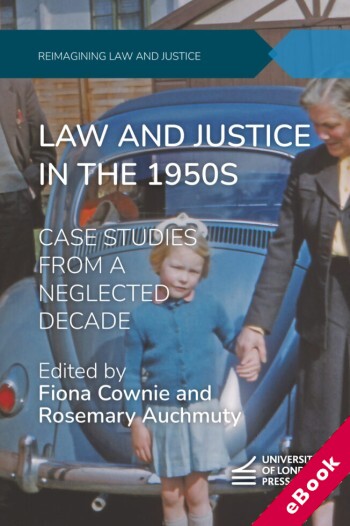
The 1950s was a decade of considerable legal development in England and Wales, despite often being regarded as very conservative in contrast to the more radical 1960s and 1970s. This collection illustrates the breadth of those developments, providing a sociolegal perspective on a range of topics across criminal, property, family, commercial, environmental and public law, and legal education. It examines the social, political and economic context of the decade to reveal how legal developments in the 1950s have much greater significance than has generally been acknowledged to date. Drawing on case studies from the Great London Smog in 1952, the treatment of women in the Wolfenden Report and divorce law reform, to the takeover battle for the Savoy Hotel in 1953, law on the radio and more, the chapters throw new light on current debates about the relationship between law and issues of justice, inclusion and equality in different spheres of activity.
Written for historians and legal specialists alike, this book explores the stories behind the laws in this neglected decade. In revealing the historical context, arguments and controversies raised at the time and the different perspectives of the parties involved, it offers a greater understanding of why we have the law we have now and of these issues as they continue to be played out in the early twenty-first century.










